
Mould and rot are caused by different groups of fungi. The grey or black speckling that appears on a painted sash in winter usually feeds on a thin film of dust, cooking grease and moisture that has settled on the paint. The fungi that rot a window are a separate group. They digest the timber itself, and they work inside the wood, where you cannot see them. So mould on window frames is a sign worth reading, but colour alone tells you surprisingly little about the timber underneath.
This guide covers that gap. It does not explain why moisture collects on the inside of windows in the first place, because that subject has its own guide. It deals with the frame: whether the growth sits on the coating, lives in the wood or is eating the wood. It also covers how to clean the first kind without stripping the finish you are trying to protect, and the signs that a cloth and a bucket are no longer the right tools.
Firm timber under a black film usually needs a careful clean and a look at the paint. Wood that gives under pressure, or grey wood under lifted paint, is a repair job, and our window restoration page shows how damaged sections are renewed. You can describe the window and its condition on the contact page.
The myth: a black frame is a rotten frame
The reasoning tends to go like this: the frame has gone black, so the wood has gone. It is an understandable leap. Rot is the expensive outcome, and black is the visible one. In fact three quite different organisms can darken a timber window, and they work at three different depths.
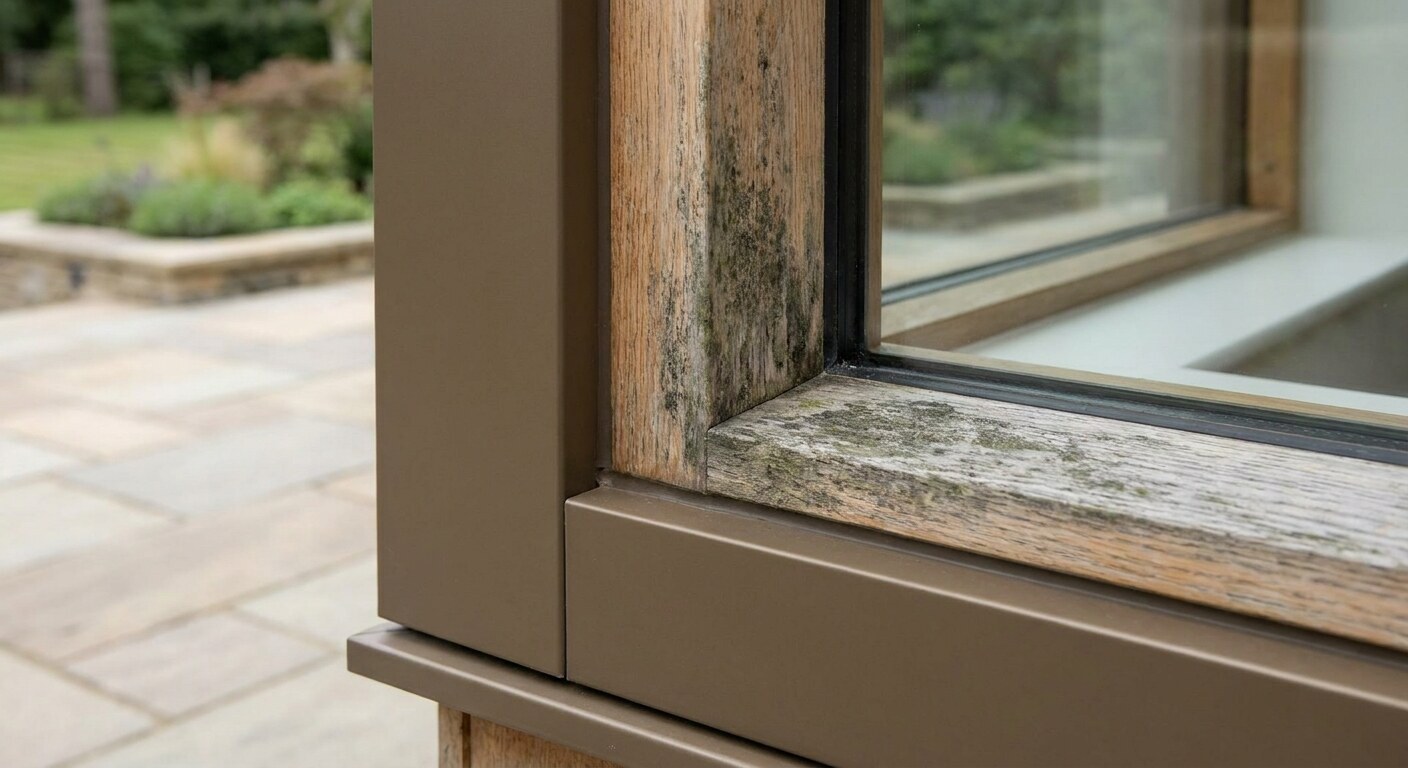
- Surface mould. Fungi growing on top of the coating, in the speckled grey, green or black colonies most people call black mould. It lives on the paint rather than in it. It feeds on whatever settles on surfaces indoors, such as dust, grease from cooking and residue from cleaning products, and it needs that film to stay damp for long enough to establish itself.
- Blue stain. Staining fungi that grow inside the outer layer of the timber and colour it blue-grey to black. They live on the sugars and starches stored in the sapwood, the paler outer part of the log that carried sap in the living tree, and they leave the cell walls largely alone. The wood is discoloured, but most of its strength is still there.
- Wet rot. Decay fungi that digest the cell walls themselves, the cellulose and lignin that make timber stiff and strong. In plain terms, the fungus is eating the window. Brown rot leaves wood darker, shrunken and cracked into small cubes that crumble between the fingers. White rot leaves it pale, soft and stringy. Both end the same way, with timber that no longer holds a screw or a joint.
Dry rot, the name that worries owners most, is a particular decay fungus that can spread through damp masonry and structural timber. The decay found in window joinery is usually one of the wet rots.
The first of the three is a cleaning and air problem. The second is a coating problem, and the third is a timber problem. The awkward part is that the third does not need to be black at all. A sash can carry a spotless white finish over a bottom rail that has gone soft, while a frame covered in black speckles can be perfectly sound under the paint.
Mould on window frames that sits on the paint
In a heated, lived-in home, a good part of the black spotting on the inside of a timber window is this surface kind. It gathers where water lingers: along the line where the glazing bead meets the glass, in the lower corners of the sash, on the bottom rail, and behind a blind or curtain that holds damp air against the frame. Why that water is there, and what changes it, is covered in our guide to condensation on windows. This guide stays with the frame.
Surface growth gives itself away in three ways.
- It wipes. A damp cloth lifts most of it, sometimes leaving a faint shadow on pale paint.
- The paint is whole. Shine a torch low along the surface and the film still has its sheen, with no blisters, cracks or flakes.
- The timber is firm. A thumbnail pressed into the corner meets hard paint over hard wood.
A sound coating is a poor meal. Paints and stains made for joinery give mould very little to live on, so the colonies feed on what has landed on the paint. This explains why the same growth appears on glass edges, rubber seals and plastic trickle vents, none of which can rot. It also explains why cleaning works at this stage. Take away the food and the water film, and the growth has nothing to stand on.
That does not make surface mould something to ignore. A coating that stays wet and dirty through a whole winter ages faster. Where the film has a hairline crack, the same damp that feeds the mould on the surface can start working on the wood beneath it. For the people in the room the concern is separate from the window. Mould releases spores, and UK public health advice treats damp and mould as a health matter, particularly for people with asthma or allergies. Black spots on paint are not a structural emergency, but they are better dealt with now than left until the next repaint.
Blue stain: the colour that will not wipe off
If the cloth comes away clean and the dark patch is still there, the colour is in the timber. On frames with a clear or translucent finish this shows as blue-grey streaks or blotches under the film, often following the grain. On painted frames it is harder to spot. Dark patches show through thin or worn paint, or the paint blisters and flakes and the wood underneath is grey-blue instead of its normal colour.
On finished joinery the technical name is blue stain in service. It refers to staining fungi that took hold after the window was made and fitted, as opposed to staining that happened in the log or the timber yard. The useful part for an owner is what the stain reveals. These fungi need the wood itself to be wet, not just its surface. Their presence means water got past the coating and stayed there for a while.
The way in is usually close by. It might be a crack in the paint at a joint, a gap at the edge of a glazing bead, failed putty on the outside, or a chip that went through to bare wood. A narrow crack pulls water in by capillary action, the same effect that lets a paper towel soak up a spill. The intact paint around the crack then slows the water's way back out. Bare timber in the rain gets wet and dries again. Timber under a cracked film can get wet and stay wet, so the paint that was meant to protect it ends up holding the moisture in. Many coating failures turn into timber problems in this slow, quiet way.
Blue stain fungi can also make the outer wood more absorbent, so a stained area takes up water faster the next time it gets wet. Each wet spell makes the next one easier.
We read blue stain as a message from the coating, not a verdict on the window. Wiping does nothing for it, because the growth is inside the timber. The fix is to find the entry point, let the wood dry, take back the failed coating locally and rebuild it. As long as the timber underneath is firm, the window has lost its looks and very little else.
Rot: test the firmness, not the colour
The belief that black means rotten has a mirror image, and it costs more: clean paint means healthy wood. Decay tends to start where water gets in and cannot easily get out, and those places are rarely the ones you see from the sofa.
Check these spots first:
- the bottom rail of each opening sash, especially its lower corners where the stiles (the upright side pieces) join it;
- the lower joints of the outer frame, where the side pieces meet the sill;
- the sill outside, including its front edge and underside;
- the putty or bead line on the outside face of the glass.
The corners matter because of how wood is built. Timber is a bundle of long hollow cells running along the length of the piece, rather like drinking straws laid side by side. Water travels along those straws far more easily than across them. Wherever the cut ends of the straws, called the end grain, meet at a joint, a hairline crack in the paint gives water a short route deep into the timber. That is why decay tends to begin at the corners of a sash while the middle of the same rail is still sound.
Outside, look under the front edge of the sill for the drip groove. This is a small channel cut along the underside so that rain drops off the edge instead of creeping back towards the wall. Once it is filled with layers of old paint, water can follow the underside of the sill back to the joint with the frame. Hardly anyone inspects that spot.
To test, use the blunt tip of a small screwdriver and firm hand pressure. A sharp point or a hammer is not needed. Sound timber resists. The tip leaves a small dent at most, and if you lever gently, it lifts a long, springy splinter. Decayed timber lets the tip sink in with little effort, feels spongy or crumbly, and breaks into short, brittle fibres. Tapping the rail with the screwdriver handle can add a clue, because soft wood often sounds duller than sound wood. Treat that as a hint, not a test.
Two cautions apply. A probe only tells you about the spot you pressed, and decay that started inside a joint can reach further than the soft patch at the surface suggests. Each hole you make is also a fresh way in for water, so test with restraint and cover the marks before the next spell of rain. A soft spot confirms damage at that point. A firm surface narrows the question but does not prove the inside is clean.
Colour tells you something grew there. Firmness tells you whether the window is still there.
If the screwdriver sinks in at more than one spot, the job has moved from cleaning to joinery. The window restoration page explains how decayed sections are replaced while the sound timber stays in place.
Cleaning surface growth without stripping the coating
When the paint is whole and the timber is firm, cleaning is the job. The aim is to remove the growth and the dirt it feeds on while leaving the coating as it was. Every scratch through the film is a future entry point for water.
Gentle beats thorough.
Before you start, open the window and keep the room ventilated. Wear gloves, and consider a well-fitting mask if dust tends to bother you. UK health guidance suggests that people with asthma, allergies or other breathing problems should leave mould cleaning to someone else.
- Skip the dry brush. Brushing dry growth sends spores into the air. A damp cloth keeps them in the cloth.
- Use a mild cleaner. The coating manufacturer's care guidance is the reference for what a finish will tolerate. Solvent cleaners, scouring creams and abrasive pads can dull or cut the film.
- Fold the cloth and keep the water fresh. Turn to a clean face of the cloth often, and change the water once it looks grey. Otherwise you are moving the growth from one corner to the next.
- Reach the corners with a soft brush. A soft brush gets into the bead line and the corner joints. Stiff bristles, knives and scrapers do not belong there.
- Rinse, then dry. Wipe over with clean water to remove cleaner residue, which can become food in its own right, then dry the surface with a dry cloth. A frame left damp after cleaning has simply been prepared for the next colony.
- Look while you work. Cleaning is the closest inspection the frame gets all year. Note any cracks, blisters, open joints and anything that stays dark after wiping.
Two tools should stay in the cupboard. A pressure washer forces water into joints and behind seals, which is the opposite of what the window needs. A scraper on painted timber removes the growth by removing the paint.
Mould is one part of looking after a timber window. The routine for washing, checking seals and touching up paint through the year is set out in our timber window maintenance guide, so it is not repeated here.
If the growth comes back in the same places after a careful clean, the frame is reporting a moisture problem rather than a cleaning one. Cleaning removes what grew. It does not change the conditions that let it grow.
When cleaning stops being the answer
Some signs move the job from the cleaning cupboard to joinery repair:
- the screwdriver sinks in at one or more points;
- paint has lifted and the wood beneath is grey, cracked or darkened;
- staining stays after cleaning, and the coating over it is blistered;
- the joints at the lower corners have opened, or a glazing bead has come loose;
- putty on the outside is cracked, missing or pulling away from the glass.
Repairs fall into three broad kinds, and the names are less technical than they sound.
Coating repair. This suits blue stain on firm wood, or a patch of failed paint. The timber is dried, the coating is taken back to sound edges and then rebuilt with a compatible system. Most of the effort goes into waiting for the wood to dry, and the hardest part is not rushing it.
Resin repair. This suits a small area of decay. The soft wood is cut back to sound timber, and the cavity is filled with a repair resin made for joinery, then shaped and painted. It works for local damage where the surrounding wood is solid.
Splicing. This suits decay that runs along a length of timber. The damaged section is cut out and a new piece of matching timber is glued in with a proper joint, so the repair carries load like the original. Think of it as a timber transplant.
Repair is not automatically the better choice. Sometimes decay runs through the bottom rail, the lower ends of both stiles and the sill all at once. Then the amount of new timber approaches a new sash, and the joints that hold everything square may be weak as well. At that point replacement can be the more sensible decision. Arguing otherwise just to save an old window would be sentiment, not advice.
The age of the window changes that calculation. Timber in many older windows came from slow-grown trees, with tight growth rings and a high share of heartwood, the darker core of the log that resists decay far better than sapwood. A good deal of softwood joinery from later decades used faster-grown timber with more sapwood in it. As a rule, an old sash with sound heartwood justifies more effort to save than a later frame where decay has spread through soft, open sapwood.
New windows are not immune either. At our factory in Kalnciems each window is finished in the workshop with a four-layer waterborne TEKNOS coating system, so the film goes on under controlled conditions rather than being brushed on at the opening. That film keeps water out of the timber. It does not stop dust settling on the inside of a sash in a damp room, where mould can grow on new paint just as it does on old. Like any finish, it needs looking after.

Questions after the first clean
Will mould show through if I paint straight over it?
It can, and the new paint may not bond well either. Painting over live growth and the dirt film it feeds on seals both under the new coating, where moisture can keep the fungus active and stain or lift the fresh paint. Clean the frame, let it dry fully, and prepare the surface as the paint maker specifies. Our guide on how to paint wooden windows sets out the full sequence.
Is it safe to sand a mouldy frame in an older house?
Not before checking the old paint. Lead-based paint was used in British homes for much of the twentieth century, and older layers can still be on window frames under later coats. Dry sanding turns those layers into fine dust that is harmful to breathe and spreads through the house. Test the paint first, and if lead is present, use methods that keep dust down or bring in someone equipped for it. Sanding also lifts mould spores into the air, so dust control matters with newer paint too.
Is bleach a good idea on a painted timber frame?
Usually not as a first choice. Bleach can whiten what sits on the surface, but it does nothing for growth inside the timber. Harsh cleaners can also dull or soften some coatings and the seals next to the glass. Start with the mild cleaner the coating manufacturer recommends. If dark staining remains after that, it is probably in the wood, which makes it a coating repair rather than a cleaning job.
Do uPVC frames get the same black spots?
Yes. Mould grows the same way on any frame that collects a damp film of dirt, which is why so much advice about black mould is written about uPVC sealant and gaskets. The difference lies underneath. A plastic profile cannot rot, while timber can if water gets past the coating. A timber frame surface can stay slightly warmer than a plastic one, but neither material is mould-proof.
Can mould on the rubber glazing seal be cleaned, or does the seal need replacing?
Surface growth on a seal can usually be wiped off with a soft damp cloth and a mild cleaner. If the seal stays stained, has hardened or cracked, or has pulled away from the glass, it may need replacing. Use the seal type fitted to that window, and follow the instructions of the seal or window system manufacturer for removal and fitting.
Are stained or oiled frames cleaned the same way as painted ones?
Broadly yes, but with more care. Stains and oils form a thinner, more open layer than paint, so water and scrubbing reach the wood more easily, and blue stain shows through them clearly. Use less water, wipe lightly and dry the surface promptly. Re-coat with the same system when the finish starts to look dry or patchy, as its maker specifies.
Our view on a black frame
A black frame is a reason to look closer, not a reason to buy new windows. Much of what darkens the inside of a timber window can be wiped away, and the paint underneath has usually been doing its job all along. The cases that matter are quieter: a stain that stays after cleaning, a blister on the bottom rail, a corner that gives under a screwdriver. Those need attention while the repair is still small and local.
Where the timber really is beyond saving, the window configurator lists the profile systems and glazing options for comparison. Until the screwdriver says otherwise, though, treat the colour as a question, not an answer. We would rather see a black frame cleaned and checked than a sound one thrown in a skip.
Timber windows and doors by Windows Latvia, Kalnciems
Need Expert Advice?
Our team can help you choose the right windows for your project - from energy ratings to installation.
Get a Free Quote