

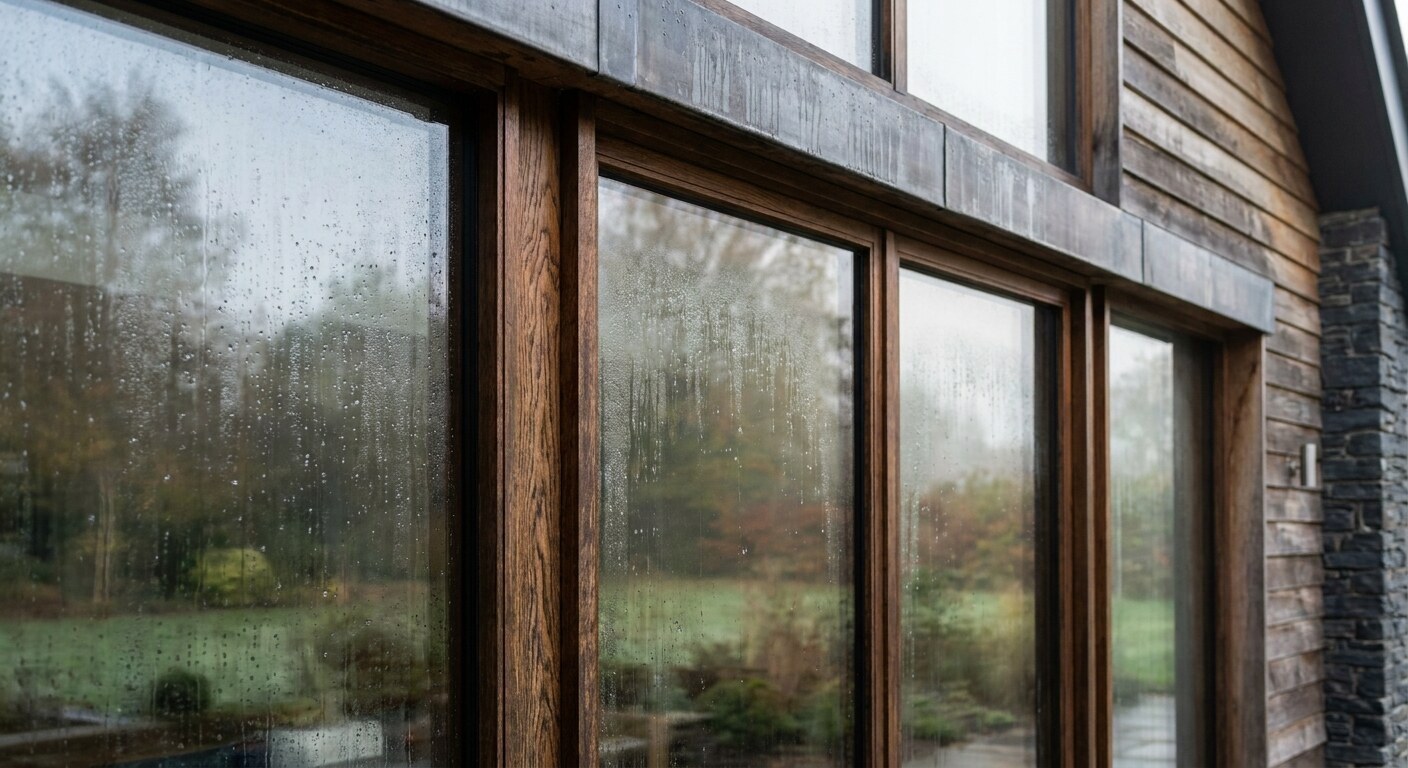
A still October morning, a clear sky, the lawn gone silver. You open the curtains and the bedroom window looks as if someone has breathed on it from the garden side. A cloth on the inside of the glass changes nothing, because the grey film sits on the outer face. By mid-morning, once the sun comes round, it has gone without a mark. People call it dew on glass, exterior misting or condensation on outside of windows. Whatever the name, on a healthy window it usually means the sealed unit is keeping the room's heat on the room side.
That leaves the outer pane about as cold as the night around it. Cold glass in damp air collects water the same way a car roof or a garden table does. It is weather on the glass, not a defect in it. There are exceptions. They are easy to separate from the normal case once you know which of the three surfaces to check.
Moisture that wipes off from outside and fades as the day warms needs no action. Moisture trapped between the two panes, where no cloth can reach, points to a failed seal, and our guide to condensation between window panes deals with that case. If one particular window fits neither pattern, describe it and its sizes on our contact page.
Why condensation on the outside of windows forms on clear, still nights
Water condenses on a surface when that surface is colder than the dew point of the air touching it. The dew point is a temperature: the one to which air would have to cool before it is saturated with the water vapour it already carries, so any surface below it gathers the surplus as droplets. On a damp British autumn night the dew point can sit close to the air temperature itself. The glass does not need to get much colder than the air for water to appear.
The clear sky does the rest. Glass facing open sky gives off heat by radiation. Under cloud, much of that heat is sent back down. Under a clear sky very little returns, and the outer pane can cool a little below the surrounding air. Wind works against the effect. Moving air keeps nudging the glass back towards air temperature, so even a light breeze makes dew less likely to settle.
Put together, the usual recipe looks like this:
- Humid outdoor air, typical of autumn and spring nights in the UK and much of northern Europe.
- A clear night sky, which lets the outer pane lose heat by radiation.
- Little or no wind, so nothing warms the glass back up before dawn.
The car on the drive is a free second opinion. If the windscreen was wet or white on the same morning, the window was reacting to the same night. A windscreen with dew on it is not a faulty windscreen. The same logic holds for the glass in your wall.
What has changed over the years is the glass. An old single pane, or an early double-glazed unit with a plain air gap, let enough of the room's heat through to keep its outer face noticeably warmer than the night. A modern unit holds that heat back, so the outer pane behaves much like a sheet of glass propped up in the garden. UK trade guidance, including the consumer advice from the Glass and Glazing Federation, treats exterior condensation as a sign that the unit is performing rather than failing.
Which surface is the moisture actually on?
Three surfaces can carry moisture on a window, and each one means something different. Finding the right one takes a minute and a dry cloth.
- Start indoors. Wipe the room-side face of the glass. If it clears, you are dealing with interior condensation, which is a different subject from this page.
- Then the outside, where it is safe to reach. On a ground-floor window, wipe the outer face. If a fingertip drags a clean black line through the grey, the moisture is outside and it will go by itself.
- If neither side clears, the moisture is between the panes.
Upper floors need a different method. Do not lean out of a window to test the glass. Waiting is enough. Exterior dew fades as sun and air warm the pane, usually by late morning, while moisture inside a sealed unit is still there on a dry, breezy afternoon.
Interior condensation has its own cause: humid indoor air meeting a cold inner surface. It is a risk you reduce rather than switch off, and ventilation, heating and indoor humidity decide how far it goes. Our guide to condensation on windows covers that side in detail.
| Where the moisture sits | What it usually means | When to look closer | Next step |
|---|---|---|---|
| Outer face of the glass | The unit is keeping heat in, and the outer pane has dropped below the dew point of the outdoor air | If it is still there on a dry, breezy afternoon | No action; it clears as the glass warms |
| Room-side face of the glass | Humid indoor air meeting a cold inner surface | Water running onto the sill, mould on reveals or seals | Ventilation, heating and lower indoor humidity reduce the risk |
| Between the two panes | The edge seal has failed and moist air has entered the cavity | As soon as you spot it: it does not clear on its own | Replacement of the glass unit, often without changing the frame |
| Outer frame and glazing bead | Dew running off the glass onto the timber | Dark bottom corners, cracked paint at the joints | Check the finish and touch up where it has cracked |
Why do new windows mist up outside when the old ones stayed clear?
Each feature of a modern sealed unit is designed to keep heat on the warm side of the glass:
- A Low-E coating on a cavity face of the inner pane reflects radiant heat back towards the room.
- Argon in the cavity slows heat transfer compared with plain air.
- A warm-edge spacer cuts the heat lost at the perimeter of the glass.
- A third pane adds a second cavity and moves the outer pane further from the room's warmth.
The result is what you paid for: less heat leaving the house. The side effect is an outer pane that sits closer to outdoor temperature, so it reaches the dew point more readily on a still night. Triple glazing tends to show it more than double glazing.
The Building Regulations push in the same direction. In England, Part L sets a limit on how much heat a replacement window may lose (Wales and Scotland run their own versions). The units fitted today are therefore better insulated than the ones they replace. Better insulation tends to mean a colder outer pane, and more mornings with dew on it.
Part F adds a twist that confuses plenty of homeowners. When windows are replaced, Part F expects the house's background ventilation not to end up worse than before, and how that is achieved depends on the ventilation the house already has. Trickle vents in the new frames are one common answer, and people reasonably assume vents should keep the glass dry. Trickle vents deal with the air inside the house. They have no influence on the outer face of the glass. Open vents and a misted outer pane on the same morning are two systems doing two different jobs, both as intended.
Why does one side of the house fog while the other stays clear?
Exterior dew is local. Two windows a few metres apart can behave differently on the same night, and the reason tends to lie around the window rather than in it.
- Orientation. North-facing elevations get no low morning sun, so dew lingers there long after the south side has cleared.
- Shelter from wind. A window tucked behind a hedge, a fence or a neighbour's extension sits in still air. An exposed one gets a breeze that keeps it near air temperature.
- View of the sky. Deep reveals, eaves, porch canopies and overhanging trees block part of the open sky, so the glass beneath them loses less heat by radiation.
- Damp surroundings. Houses near rivers, lakes, marshy ground, open fields or woodland sit in moister air and tend to see dew more often.
- Height. Cold, damp air can pool near the ground on still nights, so ground-floor windows may fog while upper ones stay clearer.
One pattern deserves a second look. Picture a row of identical windows on the same elevation, all misted, with one staying clear. The clear one may be the window losing more heat, perhaps through a unit whose seal has started to fail or a draught around the sash. It is a hint, not a diagnosis. Still, it turns the usual worry on its head. On a still autumn morning, the dry pane is the odd one out.
Am I paying more for glass that fogs?
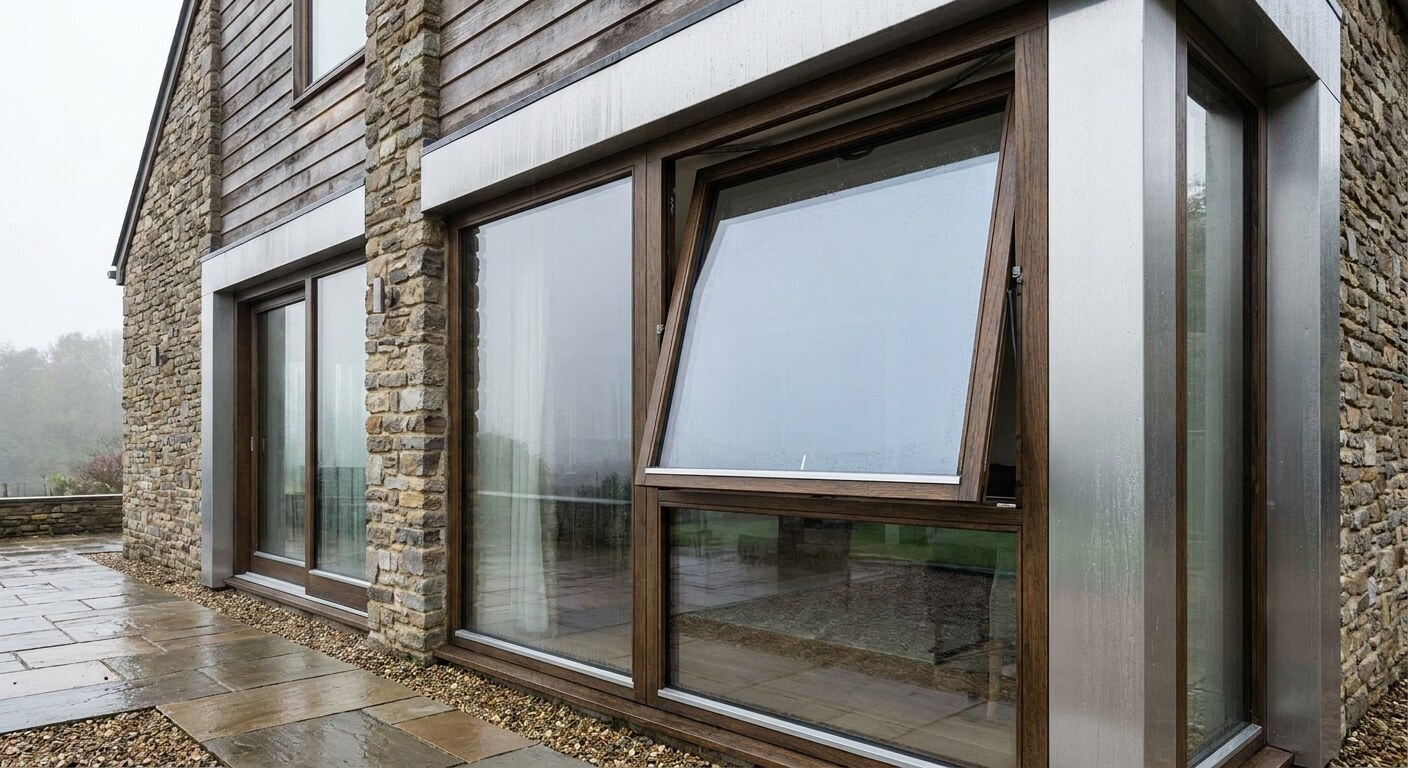
In a sense, yes. The glass that collects dew outside is the better-insulated glass. The price gap between a basic double-glazed timber window and a well-specified triple-glazed one is real. The extra pane is the visible part of that gap. Much of the cost sits elsewhere.
- The unit itself. A third pane, a second sealed cavity, coatings, gas filling and a warm-edge spacer, all assembled and sealed as one component.
- Weight. The third pane makes the sash noticeably heavier. A heavier sash needs hinges and locking hardware rated for the load, and it has to keep closing smoothly for decades.
- Frame depth. To carry a thicker unit, the timber section gets deeper. Our ECO 92 profile is 92 mm deep, against 68 mm for the double-glazed ECO 68. That means more laminated, kiln-dried timber per metre of frame, more machining and more surface to finish.
- Fitting. Heavier units mean two-person lifts, fixings that carry the weight properly and more care sealing the frame into the opening.
The triple-glazed ECO 92 reaches Uw 0.78. On still autumn mornings, dew on the outside of that glass is part of its expected behaviour.
Now the trade-off. If the grey film at breakfast bothers you more than the heat loss does, a double-glazed unit will fog up outside less often. On a sheltered elevation, or in a room you heat lightly, that is a reasonable choice and a cheaper one. What makes little sense is paying for triple glazing and then reading its dew as a defect.
Weighing glazing options for a project? The window configurator is a quick way to put a first specification together on your own sizes.
Does morning dew harm a timber frame?
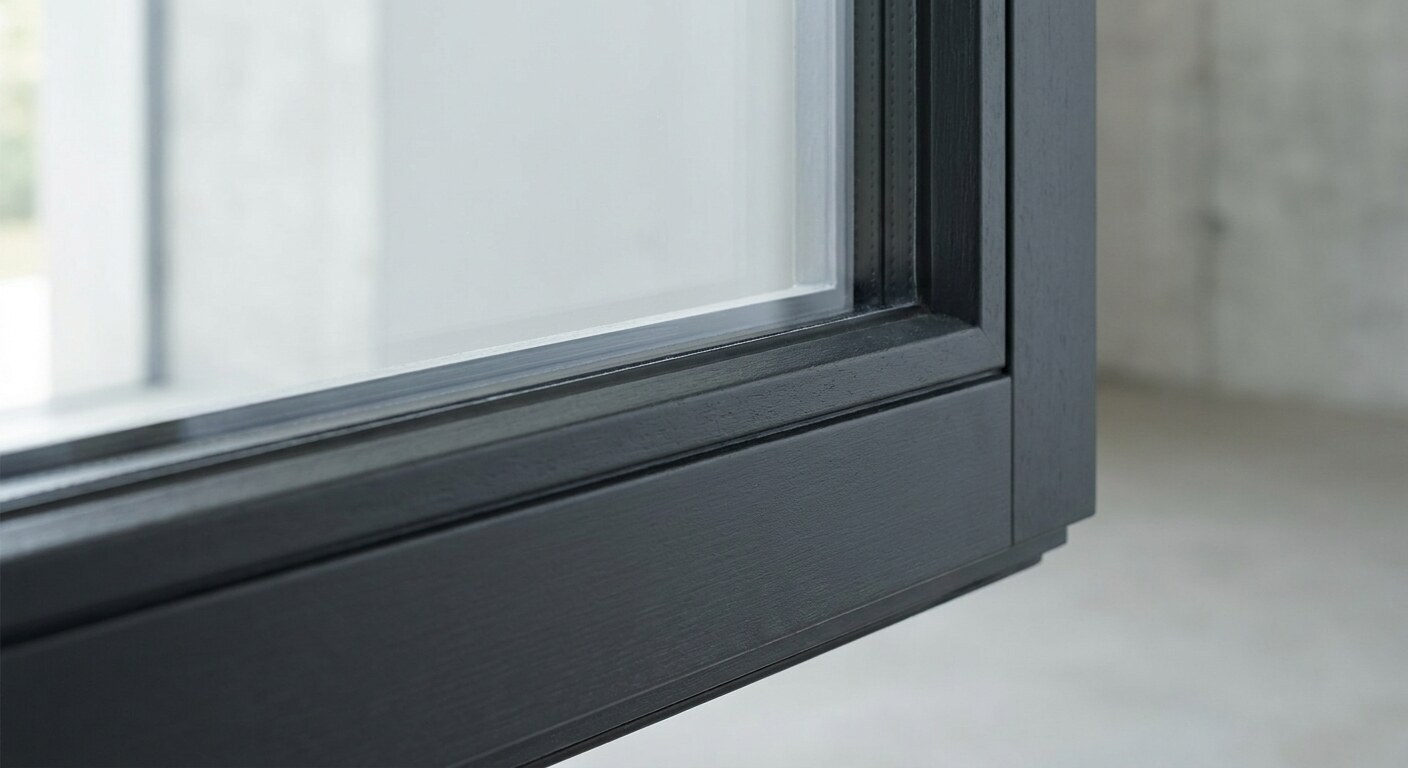
The glass shrugs it off. The frame is where exterior dew can matter. Droplets gathering on the outer pane run down onto the glazing bead and the bottom rail, then sit there until the sun dries them. Where the finish is intact, water beads up and runs off. Where it has cracked, typically at a joint or along the line where the bead meets the glass, moisture finds end grain and stays.
The early signs are easy to miss from indoors. The bottom corner of the frame looks a shade darker than the rest. The paint there has a tired, chalky bloom instead of a sheen. Nothing dramatic. But rot in a timber window tends to start in that corner, long before anything shows on the glass side.
From the factory floor in Kalnciems the logic is simple: the parts exterior dew visits are the parts a finish has to protect hardest, meaning the bottom rail, the beads and the end grain at the joints. Our windows leave with a four-coat water-borne factory finish from TEKNOS. Water-borne finishes of this kind are generally formulated to let moisture vapour leave the timber while shedding liquid water from the surface. That suits a frame that gets wet on many autumn mornings and dries by lunchtime.
A finish still needs looking after. A quick look at the bottom corners each spring and autumn, plus a touch-up where the coating has cracked, does more for the frame than anything you could do about the dew itself. Our timber window maintenance guide covers what to check and when.
Can you make exterior dew less frequent?
A little, and mostly at the design stage. Once a good unit is in the wall, the main lever would be letting more heat leak out through the glass. That defeats the point of fitting it.
- Outer-face glass coatings. Some glass manufacturers offer a coating for the outer face of the unit, designed to reduce how often exterior dew forms. It has to be specified when the unit is made, not added afterwards. Ask the supplier whether it is available for your glazing and how it affects appearance and light.
- Shelter from the sky. Canopies, deeper reveals and overhanging eaves cut the outer pane's view of the night sky. Worth knowing on a new build or an extension; rarely a reason to alter an existing house.
- Air movement. Dense shrubs pressed against the glass hold still, damp air around it. Cutting them back can let a breeze reach the pane.
Two things are better avoided:
- Car rain repellents, anti-fog sprays and household products on the outer face of coated or self-cleaning glass, unless the glass manufacturer confirms they are compatible. Some coatings can be damaged by them.
- Hot air from a hairdryer or heater on cold glass. Uneven heating puts the pane under thermal stress, and patience costs nothing.
For a typical house, the sensible approach is to let the morning do the work. Sun and moving air clear the outer pane within hours.
When does condensation on the outside of windows need a second look?
The outside dew itself is rarely the problem. These patterns point somewhere else:
- Moisture that stays all day on a dry, breezy afternoon. Recheck which surface it is on. It is probably between the panes, which means the edge seal has failed and the unit will not dry out by itself.
- Water on the room side morning after morning, running onto the sill, or mould on the reveals. That is interior condensation and a question of ventilation and humidity.
- One window clear while identical neighbours fog, as described above.
- A frame that stays dark and damp at the bottom corners long after the glass has dried, or paint lifting at the joints. The glass is behaving; the finish needs attention.
A few more questions about exterior dew
Does frost on the outer pane mean the same as dew?
Yes, it is the same process with the pane below 0 °C. When the outer glass drops below freezing on a clear night, the moisture forms as ice crystals instead of droplets. It clears the same way, as sun and air warm the glass, and on a well-insulated unit it is just as normal.
Why does it show up more in autumn and spring than in deep winter?
Those seasons tend to combine all three triggers: mild, humid nights with clear skies and little wind. In midwinter the outdoor air often holds less water in absolute terms, and long grey spells keep the sky covered, so the glass may stay dry or frost over instead.
Does a misted outer pane prove the whole house is well insulated?
No. It tells you about that glass unit and nothing else. Walls, roof, floors and draughts around the frame are separate questions, and a house can have excellent glazing set in a poorly insulated wall.
Can I put a rain repellent on the outside glass to keep it clearer?
Check with the glass manufacturer first. Many modern units carry coatings, and some products sold for car windscreens or shower screens can damage them. On plain glass, a repellent changes how droplets sit on the surface rather than whether dew forms in the first place.
A grey outer pane on a still autumn morning is about the cheapest reassurance a window can give you. The ones worth watching are the dry pane in a misted row and the bottom corners of the frame that rarely get a second glance.
Need Expert Advice?
Our team can help you choose the right windows for your project - from energy ratings to installation.
Get a Free Quote