

Put the dehumidifier away. If the mist is inside the glass, no amount of airing the room, running an extractor fan, or fitting trickle vents will touch it. That water is sealed in behind the glass where nothing you do to the room can reach it. Half the advice online about condensation between window panes spends three hundred words telling you to dry your washing outside before quietly admitting none of it applies to your problem.
So let us start with the plain truth: condensation between the two sheets of glass means the sealed unit has failed. The airtight edge seal that holds the panes apart and keeps the insulating gas in has let go. It is a mechanical failure of one component, not a damp problem with your house. And the good news buried inside that bad news is that on a properly built window you usually replace one part, not the whole thing.
Short on time? A misted unit almost always needs the glass swapped, not the whole window. On a timber frame that is a joiner's job of an hour or two. See our window and glazing options or ask us for a quote if you want it done properly the first time.
What condensation between window panes actually means
A modern double-glazed window is not two loose sheets of glass. It is a factory-made sandwich called an insulated glass unit (IGU, or "sealed unit" in the trade). Two panes are held apart by a spacer bar around the edge, the cavity is filled with a dry, still, insulating gas, and the whole perimeter is locked shut with a primary and secondary sealant. That sealed cavity is what does the insulating work.
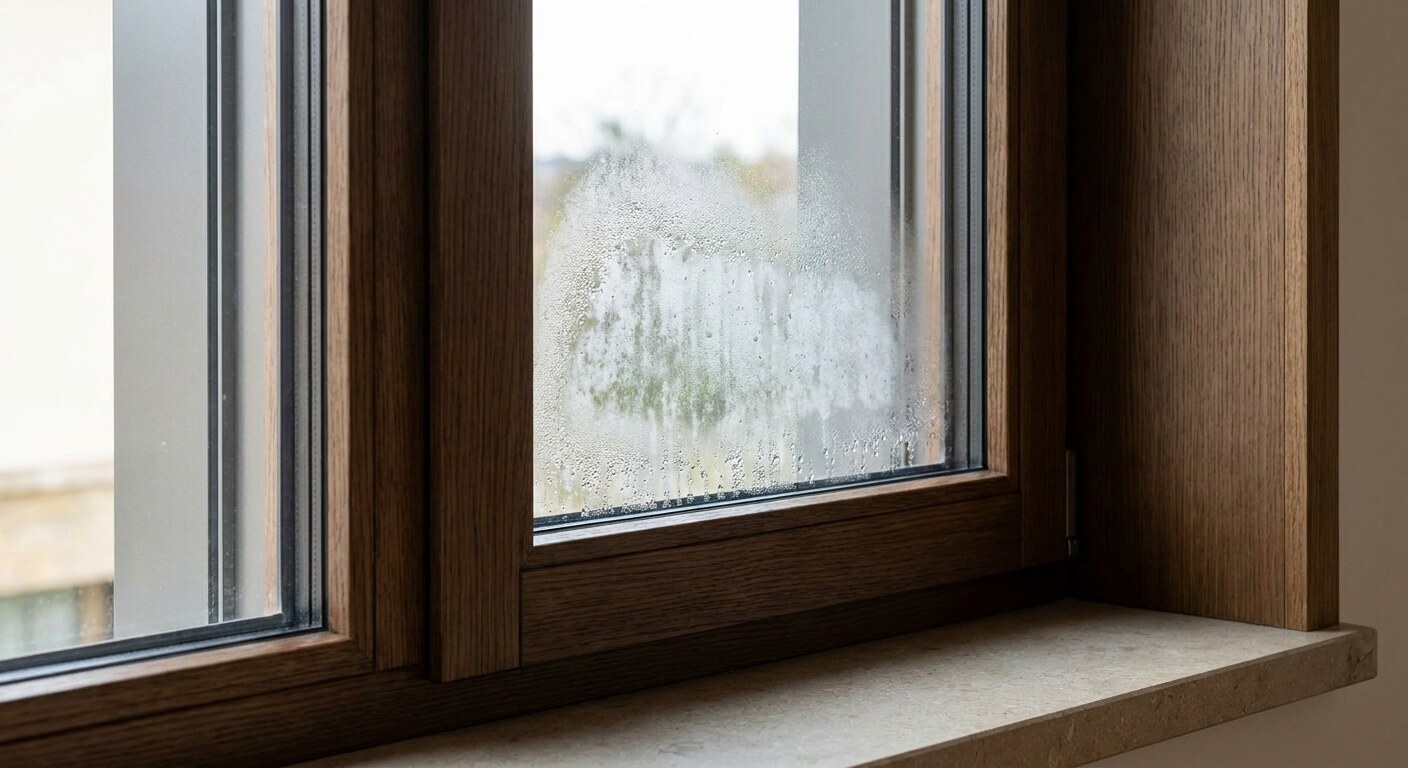
When the edge seal fails, three things happen in order. The gas escapes. Ordinary humid air seeps in to replace it. And then, on the first cold morning, that trapped moisture hits the cold inner face of the outer pane and condenses. That grey haze, or the little puddle of water sitting inside the glass you cannot wipe away, is the seal telling you it has gone.
In the UK you will hear a handful of names for the same fault. A blown window or blown double glazing is the trade term for a failed unit. A misted window or "misted up" describes what you see. All of them mean the same mechanical failure. And here is the wow moment most people miss: the most expensive-looking part of your window is often the part that needs nothing done to it at all. The frame is usually fine. It is the glass unit inside it that has failed.
Why sealed units fail (it is not always wear and tear)
Competitor blogs tend to wave a hand at "age" and "wear and tear". That is not wrong, but it hides the actual mechanism, and understanding it tells you whether your other windows are next.
The real culprit has a name: solar pumping. Every sunny day the gas in the cavity heats up and expands, pushing outward on the edge seal. Every night it cools and contracts, pulling inward. That is a tiny flex, but it happens thousands of times over the life of the window. Sun heats it, night cools it, over and over, and eventually the sealant fatigues and cracks, the same way bending a paperclip back and forth finally snaps it. South- and west-facing windows fail first because they take the most sun. If your worst-affected units are all on the sunny elevation, that is not coincidence.
Two other things speed it up. Standing water in a poorly drained frame keeps the lower edge of the seal permanently wet, and a wet seal degrades faster. And a cheap unit built with a single sealant instead of a proper dual seal simply has less to lose before moisture gets in. A well-made unit should give you a couple of decades. A poorly built one can blow in five or six years.
The ventilation myth, and how to tell which condensation you have
Before you spend a penny, work out which of three completely different problems you have, because two of them are free to fix and one is not. The quickest test is simple: try to wipe the moisture off. If you can, it is surface condensation. If you cannot, because it is trapped inside the glass, the unit has blown.
| Where the moisture is | What it means | What to do |
|---|---|---|
| On the inside face (room side), wipeable | Normal humidity, poor ventilation. Nothing wrong with the window. | Ventilate, use extractor fans, open trickle vents. See our guide to condensation on windows. |
| On the outside face (weather side), wipeable | Good news, oddly. It means the glass is insulating so well the outer pane stays cold. A sign of an efficient window, not a fault. | Nothing. It clears as the day warms. |
| Between the panes, cannot be wiped | Sealed unit failure. The seal has blown and the gas is gone. | Replace the glass unit. Read on. |
This is where most articles waste your time. They tell you to buy a dehumidifier, dry your washing outdoors, and crack a window at night. All sound advice for the first row of that table. Useless for the third. If your mist lives inside the glass, none of your household habits caused it and none will cure it.
Can moisture between window panes be repaired?
Yes and no, and the distinction matters more than any UK repair company will tell you upfront. There are two routes, and only one of them actually restores the window.
Route one: defogging
"Defogging" or "misted window repair" is a service where a technician drills a small hole into the failed unit, injects a cleaning solution to shift the moisture, blows the cavity dry, and inserts a tiny one-way valve or vent. Sometimes an anti-fog coating goes in too. The mist clears, and the glass looks clear again.
Here is the FRICTION nobody advertising defogging wants front and centre: it clears the fog, but it does not put the gas back. Once you drill and vent a unit, the sealed cavity is open to the air for good. The argon that made it a warm window is gone, and it is not coming back. You now have a clear pane of glass that insulates like a single sheet, quietly bleeding heat, showing up as a cold spot on a thermal camera and as a higher line on your winter heating bill. Defogging is cosmetic. It buys you clear glass, not a working window.
Route two: replace the sealed unit
The proper fix is to remove the failed IGU and slot in a new one, filled with argon, sealed at the factory, exactly as the original was on day one. Crucially, this does not mean ripping out your whole window. The frame stays. Only the glass unit is swapped. On a timber window this is straightforward: a joiner lifts out the glazing beads (the timber strips holding the glass in), takes out the old unit, drops in the new one, and refits the beads. An hour or two, and you have your warm window back.
So the answer to "can it be repaired" is: the fog can be masked cheaply, or the window can be genuinely restored for not a great deal more. Given how close those two prices sit in the UK, spending on the temporary fix rarely makes sense.
Why timber frames give you an easier fix than uPVC
Almost every UK article on this topic assumes a uPVC window, because most UK windows are uPVC. That leaves a gap worth filling, because a failed unit behaves differently in a timber frame, and mostly in your favour.
In our factory in Kalnciems we build the glazing bead system to be removable by design. The bead is a separate timber strip, pinned or clipped in, not welded to the frame the way a uPVC unit often is. A competent joiner can lift the beads, change the unit, and refit them without a mark on the surrounding joinery. On a bespoke or heritage frame that matters enormously: you keep the frame you paid for and only the consumable part, the glass, gets renewed.
There is one thing to watch, and it is the timber-specific risk the uPVC articles never mention. A blown unit means water is present around the glass, and if the frame's drainage channels are blocked, that water can sit against the timber. Over time, standing water is how rot starts. So when we replace a blown unit in a timber window, we check the drainage holes at the bottom of the frame are clear and the paint or stain around the glass rebate is sound. It is a five-minute check that saves a much bigger repair later. If you are keeping on top of the finish anyway, this is one of the reasons why: our timber window maintenance guide covers the drainage holes everyone forgets.
An observation from years of pulling misted units out on site: the frame is almost always in better condition than the customer feared. People see the fog, assume the whole window is finished, and brace themselves for a full replacement quote. Nine times out of ten the timber is sound and it is a glass swap. The one time in ten it is not is usually a window where blocked drainage let water sit against the bottom rail for years unnoticed, which is exactly the failure the five-minute check prevents.
Thinking about it the other way round? If several units on the same elevation are blowing at once, the window itself may simply be near the end of its service life. Our timber window range is built with dual-sealed argon units and factory-finished frames rated for 60 years, so the next set does not become a recurring bill.
What it costs to fix a blown window in the UK
Prices vary with glass size, location and access, so treat these as orientation figures for 2026, not a quote. The pattern they reveal is more useful than any single number.
- Replacing a single blown pane in a small unit: from roughly £55 for a small pane up to around £145 for a large one, depending on size.
- A standard whole sealed-unit replacement within your existing frame: roughly £120 to £250.
- A defogging / misted-repair service: roughly £70 to £250.
Read those three lines together and the trap jumps out. Defogging, the cosmetic fix that leaves you without argon, costs almost the same as a proper unit replacement that restores the window completely. You are being asked to pay near enough full price for half a repair. In most cases, paying the small difference to replace the unit and keep the insulation is the better spend, especially once you factor in the heat you would otherwise lose every winter through a de-gassed pane.
One more cost sits behind all of this and it is not on any repair quote. A blown unit is a thermal weak point in your wall. Through a British winter, an efficient double- or triple-glazed unit holds heat in; a de-gassed or misted one lets it walk out through the glass. The repair bill is a one-off. The heat loss from leaving it, or from a defog that never restored the insulation, keeps landing on the bill quarter after quarter.
The compliance point when you replace glazing in the UK
This is the part homeowners forget until they come to sell. Replacement glazing in England and Wales has to meet Building Regulations Approved Document L (Conservation of Fuel and Power), which sets a minimum thermal standard for the glass you put back in. Swapping a like-for-like sealed unit through a registered installer covers this; a bodged repair or an under-spec unit fitted informally can leave you needing to prove compliance later.
The paperwork that proves it is a FENSA certificate (or equivalent Local Authority Building Control sign-off). When you sell, the buyer's solicitor will ask for it on any window work done since 2002. Getting a proper unit fitted by a registered installer means that certificate exists; a cash-in-hand defog does not generate one. For anyone weighing up timber against the plastic alternative on cost and compliance over the long run, our wooden windows vs uPVC cost comparison lays out the full-life numbers.
How long should glazing last before it mists up?
A well-made sealed unit should give you fifteen to twenty-five years before the seal fatigues, and a good manufacturer's guarantee on the unit will typically run ten years or more. If your windows are barely past their first decade and already blowing across several openings, that points to a build-quality problem in the original units rather than fair wear.
The frame is a different lifespan entirely. A properly built and maintained timber frame lasts 50 years and beyond, which is precisely why the removable-bead design makes sense: you renew the glass, a consumable part, two or three times across the life of a frame that outlives all of them. We cover the frame side of that in how long timber windows actually last.
Frequently asked questions
How do you get rid of condensation between glass panes?
You cannot get to it from either side, because the moisture is sealed inside the glass unit. The only real fixes are to replace the sealed unit with a new argon-filled one, or to have it "defogged" (drilled and vented), which clears the mist but does not restore the insulating gas. Replacing the unit is the proper repair; defogging is cosmetic.
Will a hair dryer get rid of condensation between glass panes?
No. A hair dryer only warms the surface of the glass; it cannot reach or remove the moisture sealed inside the cavity. Any clearing you see is temporary and the mist returns as soon as the glass cools. The seal has failed and the unit needs replacing.
Can misted double glazing be repaired?
It can be cleared by a defogging service, but "repaired" is generous. Drilling and venting the unit removes the fog while leaving the cavity open to the air, so the argon gas that made it insulate is gone for good. To genuinely repair the window you replace the sealed unit, which on a timber frame is a straightforward glass swap that keeps your existing frame.
How much does it cost to replace misted double glazing?
As a 2026 orientation, a whole sealed-unit replacement within your existing frame is roughly £120 to £250, and a single blown pane from about £55 to £145 depending on size. Defogging costs a similar £70 to £250, which is why replacing the unit usually makes more sense: near the same price, but you keep the insulation.
Is it worth replacing misted windows?
If the frame is sound, yes, but usually you only need to replace the glass unit, not the whole window. A blown unit is a thermal weak point that loses heat all winter, so restoring it pays back on the heating bill. Full window replacement is only worth it when the frame itself is at the end of its life or several units are failing at once.
How long should double glazing last before misting?
A well-made sealed unit should last fifteen to twenty-five years before the seal fatigues, with manufacturer guarantees on the unit commonly running ten years or more. Windows on sunny south- and west-facing elevations fail soonest because of solar pumping, the daily expansion and contraction of the gas that slowly wears the edge seal.
The bottom line
Condensation between window panes is one component failing, not your house going wrong. The cure is not ventilation, not a dehumidifier, and not usually a whole new window. It is a new sealed unit dropped into the frame you already own, done in an hour or two on a well-built timber window. Skip the defog: paying near full price for glass that no longer insulates is the one choice that quietly costs you every winter after.
If you have a blown unit and want it put right properly, with a new argon-filled unit and a quick drainage check while the beads are off, ask us for a quote. We would rather fix the one part that failed than sell you a window you did not need.
Prepared by the Windows Latvia technical team, from our factory in Kalnciems, Latvia.
Need Expert Advice?
Our team can help you choose the right windows for your project - from energy ratings to installation.
Get a Free Quote