
Contents (12 sections)
- The short answer by product category
- The UK regulatory reference points worth knowing
- What actually determines lifespan
- Wood species lifespan comparison
- How modern factory windows compare to the old heritage frames
- Real-world examples from our projects
- How to tell if your existing timber windows have life left in them
- Maintenance schedule that reaches the 60-year mark
- When to replace rather than repair
- Frequently asked questions
- Related reading
- Need a replacement estimate for windows past their prime?
Walk through any older neighbourhood in Riga, Stockholm or Edinburgh and you will find wooden windows that have been in service longer than most of the people reading this. Some are still the originals. Others have been quietly maintained for a century by joiners whose names no one remembers. That is the honest starting point for how long do timber windows last.
Properly specified and maintained wooden windows outlive their original owners, and in many cases the buildings' first major renovation cycle. The industry consensus for modern factory-made timber windows sits at 60 years, but the upper end is measured in centuries, not decades.
The short answer by product category
| Product | Typical lifespan | Maintenance interval |
|---|---|---|
| Modern factory-finished timber (ECO 92, Premium 115) | 60-100 years | Maintenance coat every 8-12 years |
| Well-made site-finished softwood casement | 40-60 years | Repaint every 5-8 years |
| Traditional Georgian/Victorian sash (with upkeep) | 150-200+ years | Linseed oil paint every 7-10 years |
| Budget DIY-store pine casement | 15-25 years | Repaint every 3-5 years |
| Wood-aluminium clad (our alu-clad range) | 70-100 years | Exterior virtually maintenance-free, interior coat every 15 years |
| For comparison: uPVC | 20-25 years | Not maintainable, replace when failed |
The spread is dramatic because the word timber covers everything from a £40 cottage casement you paint yourself on a Sunday to a factory-finished passive-house frame in kiln-dried laminated oak. What they share is a material that can be repaired; what separates them is how long you get before repair first becomes necessary.
The UK regulatory reference points worth knowing
If you are specifying or buying in the UK, two benchmarks matter:
- Building Regulations Approved Document L (2022 edition, in force across England). For replacement windows in existing dwellings the limiting (maximum) U-value is 1.4 W/m²K; for new builds 1.2 W/m²K (Approved Document L Volume 1, 2021 ed. + 2023 amendments) at the whole-window level. Timber products comfortably clear both - what matters is how far below the minimum a well-specified timber can go (our ECO 92 at 0.78 is roughly half the regulation minimum).
- FENSA Consumer Code and the British Woodworking Federation (BWF) Code of Conduct. These are voluntary but widely recognised. FENSA-registered installers sign off Approved Document L without separate building control; BWF members commit to specific durability and manufacturing standards. Either is a reasonable proxy for a quality supply chain.
Neither framework specifies a minimum design life for timber windows - but the industry practice around them assumes 20-25 years as an acceptable warranty floor and 60+ years as the target service life for quality-tier manufacturing. Budget products fall short of the floor. Quality-tier products, properly maintained, exceed the target.
What actually determines lifespan
Six factors do 95% of the work. In order of importance:
1. Timber species and grade
Oak, larch, and meranti outperform pine on durability by a factor of two to three. Modern engineered timber, laminated pine with the knots removed and the grain orientation randomised between layers, closes much of that gap and is what we use as our ECO 68 and ECO 92 standard. Raw unlaminated softwood with defects in structural zones will fail within 20 years regardless of anything else you do.
2. Moisture content at installation
If the timber still contains more than 14% moisture when it is coated and installed, the frame will shrink, crack the paint film, and admit water within five years. Factory-made windows are kiln-dried to 10-12% before milling. Site-joined frames from a carpenter who bought the stock on Friday and installed it on Monday are rarely better than 18%.
3. Coating system and factory application
A four-coat TEKNOS waterborne system applied in a dust-free factory at controlled humidity lasts 8-12 years before it needs a maintenance coat. The same products applied by a decorator on a damp March morning last three years at best. The factory environment is the hidden difference that makes modern timber windows outperform hand-finished ones.
4. Design details that shed water
Sloped sills. Drip grooves on the underside of the outer sash rail. Sealed end-grain on vertical members. A small gap for water to exit at the bottom of the glazing bead rather than sit against the timber. These details are invisible on a glossy brochure photograph but they decide whether the frame lasts 25 years or 65.
5. Climate exposure
South-facing elevations take the most UV and the most heat-cycling. They fail first by a margin of 30-40%. A window on the sheltered north side of the same house in the same climate will outlast its south-facing twin by 15-20 years. Hardwood on the south, softwood on the north, is a sensible specification choice for houses exposed to strong sun.
6. Homeowner maintenance
Annual inspection, 20 minutes of detergent wash each spring, a maintenance paint coat at year 10. Skip these and you halve the lifespan. Do them and you reach the upper end. Our guide to painting wooden windows covers the details.
Wood species lifespan comparison
Because species matters more than almost any other variable, here is the long-form detail on how each of the four timbers we offer performs against the 60-year baseline.
| Wood species | Typical lifespan | Strengths | Best for |
|---|---|---|---|
| Laminated pine | 60-80 years | Dimensionally stable, cost-effective, paint-friendly | Painted finish, everyday housing |
| European oak | 80-150 years | Dense, naturally rot-resistant, prestige | Stained or clear finish, heritage |
| Meranti | 80-120 years | High natural moisture resistance, stable | Coastal, high-humidity locations |
| Larch | 70-100 years | High resin content, silvery untreated patina | Unpainted natural weathered finish |
The numbers assume factory coating and the maintenance schedule given earlier. Neglect halves these figures; exceptional environments and attentive owners have produced 200+ year service on oak and larch.
How modern factory windows compare to the old heritage frames
A common assumption is that the old sashes you see still working on a Victorian house are somehow better than modern manufactured windows. Partly true, partly marketing nostalgia.
The old frames survived because they used slow-grown Baltic pine with 15-20 growth rings per inch of cross-section, tight and resinous and naturally rot-resistant. That timber species at that grade is no longer commercially available. What modern manufacturers do instead is laminate three layers of fast-grown farmed pine with opposing grain orientation and waterproof glue. The laminated product is dimensionally more stable than the old solid stock, even if it lacks the raw density.
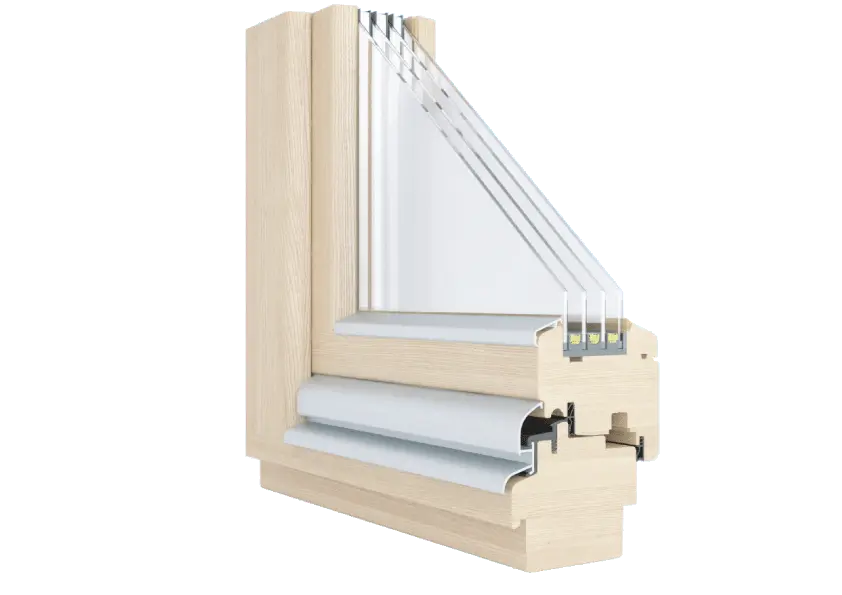
The second factor is coating. Georgian sashes were painted in lead-based linseed oil paint that flexed with the timber and never fully cured. Modern equivalents use zero-lead waterborne acrylic that is more UV-stable but less flexible. Net result: modern frame lasts at least as long as the old one, sometimes longer, but the failure mode is different.
If you want to buy frames engineered to outlast a century, modern manufacturing meets or exceeds what the Victorian joiners produced, with better thermal performance thrown in. The honest caveat: the cheapest modern timber windows do not. Opt for a budget £200-per-frame product, and you get 20 years. Budget £800+ per frame in a quality manufacturer's specification and you enter the 60+ year range.
Real-world examples from our projects
A few installations we have documented:
- Balozu iela, Riga - heritage block thermal retrofit: original pine sashes had been in continuous service for generations. We replaced them only when the owner wanted modern thermal performance, not because the frames had failed. The old sashes were still closing squarely at the point of removal.
- Upplands-Bro, Sweden: ECO 92 triple-glazed installation in Scandinavian pine, inspected at the 10-year service point. Paint film intact, no maintenance required yet. Projected service life puts this installation well past 2075.
- Stockholm project: ECO 92 tilt-turn windows specified for a passive-house-grade retrofit. Annual inspections confirm the coating is still factory-condition.
Beyond our own portfolio, Latvia's architectural record makes the point better than any marketing copy could. Rundāle Palace, built between 1736 and 1768, still has functioning wooden windows from the original joinery - maintained, repainted, and occasionally spliced by successive generations of craftsmen, but structurally the same frames. A timber window is, genuinely, a multi-generational component if the specification and the upkeep are right.
How to tell if your existing timber windows have life left in them
A five-minute inspection covers it:
- Push a screwdriver into the bottom of each sash and the outer sill. Sound wood resists; soft wood allows the blade to sink in. Soft wood is rot and needs treatment now.
- Run a finger along the paint film. Firm and continuous = healthy. Chalky or flaking = repaint due soon.
- Look at the joints between sash and frame. Hairline cracks running parallel to the grain are normal and fillable. Cracks crossing the grain are structural and indicate movement.
- Check the glazing bead seal. If water has tracked down the inside of the glass, the sealant has failed and needs refitting.
- Operate the sash. Should open and close smoothly. Binding or scraping means either paint build-up or sash swelling; both are fixable.
If all five checks pass, your existing frames probably have another 15-30 years in them. If two or more fail, it is time to price replacement. Our specifier page lays out what a proper replacement quote should contain.
Maintenance schedule that reaches the 60-year mark
For homeowners who want the boring, correct version:
| Year | Action | Time per window | Cost per window |
|---|---|---|---|
| Every spring | Wash with mild detergent, inspect seals | 15 min | £0 |
| Every 2 years | Lubricate hardware, grease hinges | 20 min | £3 |
| Year 8-12 | First maintenance topcoat (exposed elevations) | 4-5 hrs | £55 |
| Year 20 | Reseal glazing beads, check drainage grooves | 30 min | £10 |
| Year 20-25 | Second maintenance topcoat | 4-5 hrs | £55 |
| Year 35-40 | Full repaint, replace gaskets, service hardware | 6-8 hrs | £90 |
| Year 60 | Full inspection; most frames still sound | 30 min | £0 |
Total lifetime maintenance cost per window across 60 years of service: roughly £215 - £250. That is less than the cost of a single budget uPVC replacement at year 25.
When to replace rather than repair
Repair wins until the point where the number of damaged components exceeds the sound ones. A couple of rotten sections can be cut out and replaced with new timber; splits in a rail can be epoxy-repaired. But once the soft areas exceed around 25% of a sash or frame, you are patching a failing system rather than maintaining a sound one. At that point replacement is cheaper than continuous repair.
The other replacement trigger is thermal performance. A 1960s timber window with single glazing and Uw around 4.8 W/m²K is letting four to five times more heat out than a modern triple-glazed equivalent at Uw 0.78. The energy savings from swapping typically pay back the replacement cost in 7-12 years in the UK climate, faster in Nordic climates where heating costs are higher.
Frequently asked questions
Do wooden windows last longer than aluminium?
Yes and no. Good quality aluminium windows last 40-50 years, but the visual finish typically fails at around 20-25 years as the powder coat degrades. Timber keeps its finish maintainable throughout its full life. Wood-aluminium composite windows combine both: timber interior with aluminium exterior cladding, achieving 70-100 years of service life.
How often do wooden windows need repainting?
A factory-finished timber window from a quality manufacturer needs its first maintenance coat at 8-12 years. Site-finished windows typically need repainting every 5-7 years. Heritage linseed-oil-painted sashes need recoating every 7-10 years. Modern alu-clad windows need no exterior repainting at all.
Are 50-year-old timber windows worth restoring?
Almost always yes. Even if the coating has failed and sections need splicing, the frame timber itself is usually sound Baltic pine that cannot be bought new today. Restoration plus new double-glazed units typically costs 40-60% of replacement and preserves the property's character. In listed buildings and conservation areas, restoration is often the only option the planners will approve.
What is the longest-lasting wood for window frames?
Teak tops the durability chart but is prohibitively expensive and ethically problematic. European oak and larch are the practical top tier. Meranti (a tropical hardwood) is excellent but requires FSC certification checks. Our standard specifications cover all four: pine for value, oak for premium, meranti for coastal, larch for unstained natural finish.
Will my timber windows add value to my property?
In period properties and conservation areas, measurably yes: 3-8% price premium over identical properties with uPVC. In modern builds the premium is smaller (1-3%) but still positive. No buyer ever turned down a property because its windows were timber.
What happens if I never maintain my timber windows?
Without any maintenance, a modern factory-finished timber window will last around 25-30 years before the coating fails and water begins to penetrate the timber. That is still longer than an unmaintained uPVC window, but it is two-thirds less than the frame is capable of. The coating is what protects the wood. Skip the maintenance coat at year 10 and you lose 30 years of service life.
Related reading
- The best paint for exterior wooden windows: manufacturer guide 2026
- How to paint wooden windows: 6-step manufacturer process
- Wooden windows vs uPVC: real cost comparison 2026
- Our ECO 68, ECO 92, and Premium 115 profile specifications
- Wood-aluminium clad windows (70-100 year service life)
Need a replacement estimate for windows past their prime?
If your existing timber windows have reached the 25% damage threshold described above, or if you are considering thermal upgrade even though the frames are sound, we can quote replacement or restoration. Our factory holds 41 independent test reports covering the ECO 68, ECO 92 and Premium 115 profiles - including accelerated weathering tests whose extrapolated data supports the 60-year service target above. Call Kristiana on +371 27 063 302 or email [email protected]. Our B2B specifier page has the technical data architects and specifiers need for a full replacement analysis, and for UK work we coordinate with FENSA- or Certass-registered installers so Approved Document L compliance is handled at the supply-chain level.
Written by Kristiana Lipenite, Project Manager and Estimator at Windows Latvia. Questions on a specific project or restoration decision? Call +371 27 063 302 or see our B2B specifier page.
Need Expert Advice?
Our team can help you choose the right windows for your project - from energy ratings to installation.
Get a Free Quote