

Contents (14 sections)
- Quick answer: the 25-year cost picture
- Purchase price: why timber costs more up front
- Lifespan: where the uPVC story falls apart
- Maintenance cost: overstated in the uPVC marketing
- Energy efficiency: a tie on paper, a timber win in practice
- Sound insulation
- Property value and kerb appeal
- Environmental impact
- When uPVC does make sense
- What a good timber window costs in 2026
- How to get a quote that you can actually compare
- Frequently asked questions
- Related reading
- Ready for a realistic quote?
Timber windows cost more on day one. uPVC is cheaper by roughly £450 to £700 per frame in 2026 UK pricing. That gap is real, and it is the only round where uPVC wins.
Run the same comparison across 25 years and the maths inverts. uPVC needs replacing once, sometimes twice. A properly maintained timber sash keeps going for 50 to 60 years. Once materials, fitting, maintenance, energy bills, and the cost of being without windows during a tear-out are added up, the cumulative totals change shape.
Typical UK 2026 totals for a standard 1200 x 1400 mm casement, supplied and fitted: uPVC £1,100 to £1,600 over 25 years. Timber £1,000 to £1,650 over the same period, except the timber window is still working when the clock runs out.
This is the real wooden windows vs uPVC cost comparison for 2026, with numbers from quotes going out to homes in the UK, Ireland, Germany, and the Nordic countries. No marketing spin, just purchase price, maintenance, energy, and resale run side by side.
Quick answer: the 25-year cost picture
For a typical 1200 × 1400 mm casement window, supplied and installed, in the UK in 2026:
| Item | uPVC | Timber |
|---|---|---|
| Initial cost per window (supplied & fitted) | £550 - £800 | £850 - £1,400 |
| Expected lifespan | 20 - 25 years | 60+ years |
| Maintenance over 25 years | £0 (but replace) | £150 - £250 |
| Second replacement at year 25 | £550 - £800 | £0 (still working) |
| 25-year total per window | £1,100 - £1,600 | £1,000 - £1,650 |
By the time you have paid to replace a uPVC window, a well-specified timber window is past the halfway point of its service life and still performing. On a ten-window house, the lifetime delta works out to between £0 and £3,000, in favour of timber in most scenarios.
That's before we factor in energy bills, property value, and the aesthetic and environmental arguments. Those all widen the gap further.
Purchase price: why timber costs more up front
Timber does cost more to manufacture than plastic, and there is no point pretending otherwise. A hardwood frame has:
- More raw-material value per linear metre (kiln-dried laminated pine or oak versus extruded PVC profile).
- More labour per unit. CNC milling, multi-stage impregnation, and four-coat finishing systems take more production hours than welding PVC corners.
- Higher hardware specification on quality products. Manufacturers who bother with timber typically also specify Gretsch-Unitas, Siegenia, or ASSA ABLOY hardware, not the bargain-bin ironmongery you often get in the cheapest PVC ranges.
This is where the 30-40% price advantage of Latvian manufacturing becomes genuinely useful. Our factory in Kalnciems builds to the same performance and hardware standard as a Norwegian or Danish brand, but the labour cost structure in Latvia lets us land a triple-glazed ECO 92 casement at roughly the same price as a mid-range uPVC equivalent. At that crossover point, the entire lifetime-cost argument becomes decisive.
Lifespan: where the uPVC story falls apart
The industry-accepted service life for uPVC windows in Northern Europe is 20 to 25 years. That is not pessimism, that is what the extrusions actually do. UV degrades the surface plasticisers, gaskets harden, hinges corrode, and the welded corners lose their seal. By year 20, most uPVC windows show visible yellowing on south-facing elevations, draughts around the sashes, and a distinct loss of operating smoothness.
Timber, by contrast, is a maintainable material. A frame that has been coated properly in the factory and recoated every eight to twelve years during its life will pass sixty years without its structural timber needing replacement. There are functional wooden windows in Scandinavian churches and Baltic town halls that are two hundred years old and still operating. You cannot say that about any plastic product.
The practical consequence: when a homeowner tells us "I'll sort the windows and then not have to think about them again", timber is actually the answer. Plastic is the option you pay to replace in your retirement years.
Year-by-year cost comparison on a 10-window house
To show where the lifetime cost tips, here is the same 10-window house followed across three decades:
| Year | uPVC cumulative | Timber cumulative | What happens |
|---|---|---|---|
| Year 0 (install) | £6,750 | £11,250 | Purchase + installation |
| Year 10 | £6,750 | £11,750 | Timber: first maintenance coat |
| Year 20 | £7,050 | £12,250 | uPVC: early gasket repairs begin |
| Year 25 | £13,800 | £12,750 | uPVC: full replacement required. Timber: second maintenance coat. |
| Year 30 | £13,800 | £12,750 | Timber still operational, no major cost |
The crossover point in this worked example is around year 22. After that, every year the timber keeps working is pure advantage against the uPVC replacement cost, and by year 30 timber is running £1,050 cheaper on a ten-window house and still has 30+ years of service ahead of it.
Maintenance cost: overstated in the uPVC marketing
The headline claim for plastic is "maintenance-free". This is only true if you compare it against timber that is never touched. Realistic timber maintenance over a 25-year window of service:
- Annual wash with warm soapy water: 20 minutes, £0.
- Hinge and lock lubrication every two years: 30 minutes, a £5 can of PTFE spray.
- Paint or stain top coat at years 8-12 on exposed elevations: £50 in materials and a weekend if you do it yourself, or £150 to £300 per window if a decorator does it.
Total over 25 years: around £150 to £250 per window if you do the recoats yourself, or roughly £350 to £650 if a decorator does them. Either way it is less than the cost of a single call-out for a replacement uPVC gasket at year 18, once the original run goes out of production.
The "maintenance-free" story also assumes the uPVC product will look acceptable after fifteen years. In south-facing elevations, it often does not. Yellowing is a cosmetic fail that people replace windows over, even when the units are technically still working.
The deeper story on coating durability and why factory-finished timber outlasts site-painted stock is covered in our guide to the best paint for exterior wooden windows.
Energy efficiency: a tie on paper, a timber win in practice
Modern mid-range uPVC reaches Uw 1.2 to 1.4 W/m²K with standard double glazing; upgraded to triple glazing, good uPVC reaches roughly Uw 0.9 to 1.1 (best-in-class 0.7 to 0.8). Modern quality timber hits Uw 0.78 with triple glazing and Uw 0.67 with quadruple glazing on our ECO 92 profile, and Uw 0.6 on the Premium 115. The two materials are closer on U-value than the marketing on either side suggests; timber's edge shows most clearly at the passive-house end, and in the lifespan and detail arguments below.
UK context: Building Regulations Approved Document L (2021 edition, in force across England since June 2022) sets a maximum (limiting) whole-window Uw, not a minimum: 1.4 W/m²K for replacement windows in existing dwellings, and 1.6 W/m²K for new builds, with a stricter 1.2 W/m²K notional target that the overall energy calculation effectively forces. Both mid-range uPVC and any modern timber product clear those bars comfortably. What the regulations do not reward is the gap below the limit, and that is where timber and the best uPVC pull away from average plastic. If you are specifying for a low-energy retrofit or building to Passivhaus, our ECO 92 and Premium 115 reach roughly half the Part L limit (Uw 0.6 to 0.78 versus 1.4), territory only the best uPVC triple systems approach.
There is a second-order effect worth naming: timber has about 0.13 W/mK thermal conductivity. uPVC has 0.17 W/mK, but it depends on steel reinforcement inside the extrusion to stay straight in large openings, and steel is 50 W/mK. That is a thermal bridge running through the middle of every sash and frame. Timber needs no reinforcement, so there is no bridge.
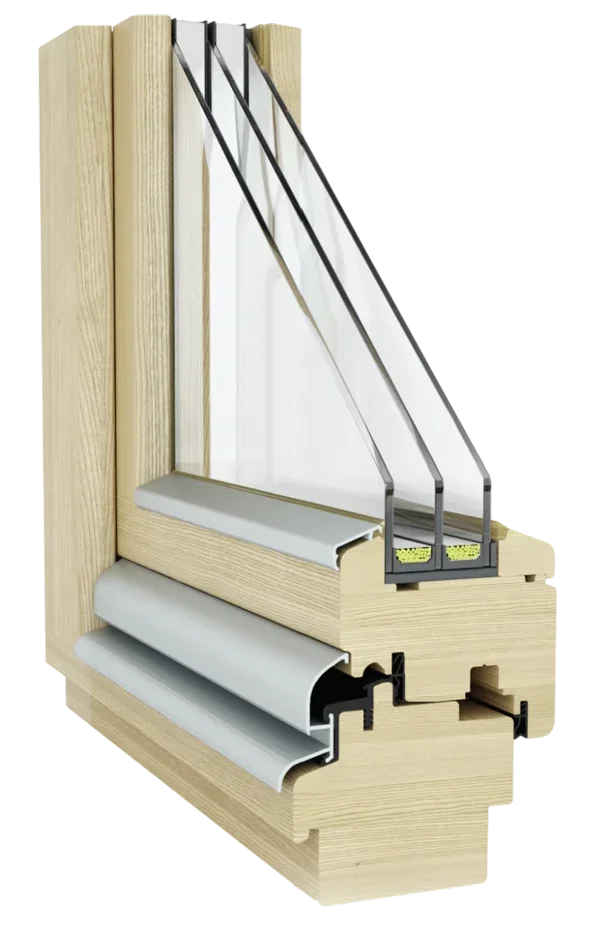
For a three-bed house with ten windows, replacing Uw 2.0 old units with Uw 0.78 timber typically saves £180 to £260 per year on heating. The same swap to uPVC at Uw 1.3 saves about £120 to £170. Over 25 years, that difference alone is £1,250 to £2,250 in the timber column.
Annual energy savings by climate zone
The heating-cost advantage of lower Uw is climate-dependent. In a Mediterranean climate the delta shrinks to near zero; in a Nordic one it dominates the whole economic case.
| Location | Annual saving: timber vs uPVC | 25-year saving | Why |
|---|---|---|---|
| Norway / Sweden / Finland | £320 - £480 | £8,000 - £12,000 | Long heating season, high electricity cost |
| UK / Ireland / Netherlands | £140 - £220 | £3,500 - £5,500 | Temperate, gas-heated |
| Germany / Austria | £180 - £260 | £4,500 - £6,500 | Continental, longer winter |
| Southern France / Northern Italy | £60 - £120 | £1,500 - £3,000 | Short heating season |
These numbers are calibrated against 2026 energy prices. They will rise roughly with inflation over the life of the window, so actual savings in 2046 are likely to be higher in absolute terms.
Sound insulation
Timber frames dampen sound better than plastic because wood is denser and less resonant. A standard triple-glazed timber window delivers around 32 dB of sound reduction, and with acoustic glazing specified this rises to up to 40 dB in our tested configurations. A comparable uPVC unit typically comes in a couple of dB lower on the same acoustic spec. For anyone living on a busy road or near a railway, those extra decibels are the difference between a conversation and a low rumble in the background.
On our ECO 92 profile with acoustic glazing, we reach the upper end of that range (up to 40 dB Rw) for urban projects where street noise is the primary concern. Equivalent uPVC installations require specialist acoustic hardware to close the gap, which pushes their price above timber in most configurations.
Property value and kerb appeal
This one is well established in UK and Irish estate-agent data: homes with timber sash or casement windows in period or traditional properties sell for 3-8% more than equivalent properties with uPVC. In listed buildings and conservation areas, the Planning (Listed Buildings and Conservation Areas) Act 1990 does not name or ban uPVC, but it requires alterations to preserve a building's character, and in practice conservation officers routinely refuse plastic replacements for period sash or casement windows (listed-building work also needs Listed Building Consent). For those properties, timber is effectively the only approvable option.
For a modern build or a 1980s/1990s house, the delta is smaller, maybe 1-2%, but the direction is the same. No one has ever upgraded from timber to uPVC for aesthetic reasons. Plenty of homeowners go the other way.
Property value impact by property type
| Property type | Value uplift: timber vs uPVC | Notes |
|---|---|---|
| Listed building / conservation area | 5 - 8% | uPVC usually refused on heritage grounds |
| Victorian / Edwardian / Georgian | 4 - 6% | Buyers value period correctness |
| 1930s - 1950s character | 2 - 3% | Timber restoration marketable |
| Post-1990 modern build | 1 - 2% | Premium finish signal |
| Passive house / architect-designed | 3 - 5% | Triple-glazed timber expected at this spec |
Environmental impact
Timber windows sequester carbon while they are in service. A single window frame locks up roughly 50 kg of CO₂ equivalent. uPVC windows emit around 85 kg CO₂e during manufacture and are harder to recycle: although uPVC can be mechanically recycled, in practice much of it is downcycled, landfilled, or incinerated.
For buyers who care about embodied carbon, the numbers are stark. Over a fifty-year building design life, timber windows store more carbon than they emit when paired with FSC-certified timber like we use, while uPVC stays carbon-intensive across every phase.
When uPVC does make sense
We will not pretend it is never the right answer. The scenarios where plastic wins:
- Rental properties you plan to sell inside 10 years. If the window will outlast your ownership, lifetime cost does not accrue to you.
- Absolute bottom-of-budget installations where the only alternative is doing nothing. Bad uPVC beats rotten single glazing.
- Secondary elevations where the window is not visible and the building has no conservation value. A uPVC window in a garage or a utility-room back wall is a sensible call.
For the main elevation of any house you intend to live in long-term, the economics, the aesthetics, and the environment all pull the same direction: timber.
What a good timber window costs in 2026
Here is a realistic price range for a well-specified Latvian-made timber window, delivered to the UK or Ireland in 2026:
- ECO 68 double-glazed casement, pine, standard white paint: £650 - £850 per window supplied.
- ECO 92 triple-glazed tilt-turn, pine, factory-coated in your chosen RAL colour: £950 - £1,250.
- Premium 115 quadruple-glazed, oak, with exterior aluminium cladding: £1,400 - £1,850.
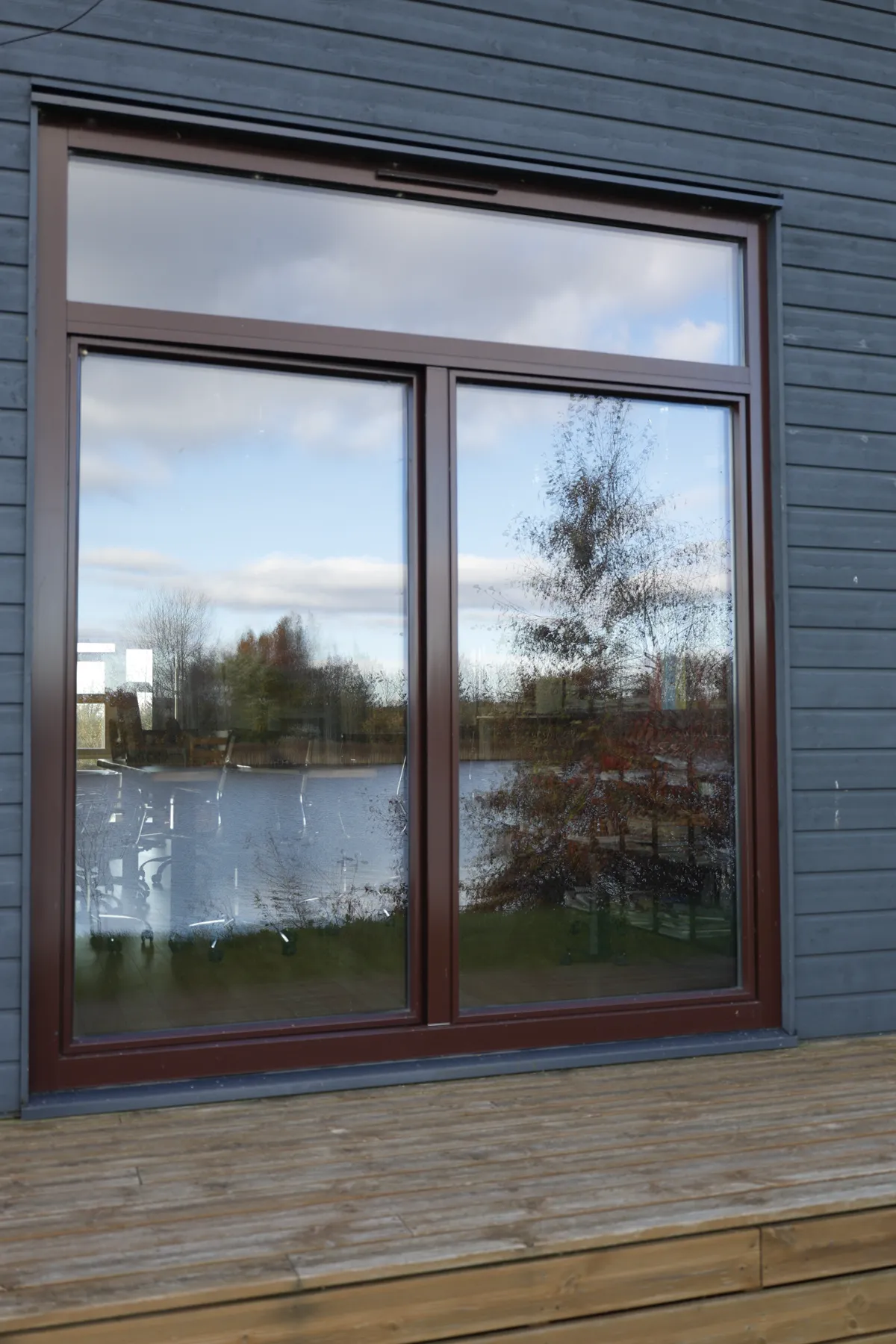
Installation on top, £150 to £300 per window depending on access and whether scaffolding is required.
These prices are what makes our B2B programme viable across the UK and continental Europe: we land factory-finished triple-glazed timber in Riga, ship by road, and the delivered total is still below what the local Scandinavian brands charge for lower specifications. We have shipped to 19 countries over the past decade, and the pricing that clears a UK quote sheet has become the same benchmark our B2B customers use when they compare domestic suppliers: our landed UK price is typically 30-40% below the Scandinavian tier and at parity with mid-range UK timber joinery, at a genuinely higher specification.
How to get a quote that you can actually compare
Comparing window quotes fairly is harder than it should be, because different suppliers specify different things. A quote for "double-glazed timber" from one supplier is not comparable to "triple-glazed 36 mm insulating glass unit with warm-edge spacer and argon fill" from another. When you request quotes, ask every supplier to state:
- Profile depth (68, 78, 92, 115 mm)
- Uw value of the complete window (not just the glass Ug)
- Glazing specification including coating and gas fill
- Frame species and grade
- Coating system (brand and number of coats)
- Hardware brand
- Warranty terms on frame, coating, and glass
If a supplier cannot answer those seven questions in writing, that is itself useful information. Our standard quotes arrive with all seven and a technical data sheet, because specifiers need them to build the decision matrix properly.
Frequently asked questions
Are timber windows really worth the extra cost?
Yes, once you run the 25-year lifetime cost. The first 10 years favour uPVC because it is cheaper to buy. Years 15-25 flip the calculation entirely, because timber keeps working and uPVC needs replacement. For a house you intend to keep more than 15 years, timber is the cheaper total cost.
Can I get triple glazing in uPVC?
Yes, and good uPVC triple glazing performs well, around Uw 0.9 to 1.1 W/m²K. The catch is that the price premium narrows the purchase-price gap to timber to almost nothing, and at that point timber wins on lifespan, repairability and resale.
Do timber windows need painting every year?
No. A factory-finished timber window from a modern manufacturer needs its first maintenance coat at 8-12 years. Annual washing is all that is required in between.
Do replacement windows need trickle vents in the UK?
In most cases, yes. Under Building Regulations Approved Document F (2021 edition, in force since June 2022), replacement windows in England must keep at least the background ventilation the old ones had, and add trickle vents where there were none, typically around 8,000 mm² equivalent area for habitable rooms and 4,000 mm² for bathrooms and utility rooms. The main exception is a home with continuous mechanical ventilation such as MVHR. We supply both timber and uPVC with integrated trickle vents to suit.
Is timber more secure than uPVC?
At the hardware level, the frames are comparable; security comes from the locking points and the glass specification. We hold Secured by Design accreditation and PAS 24 certification on the relevant product lines, so a specified timber window will meet UK security requirements for new-build and insurance purposes.
Will timber windows increase my house insurance?
No. Underwriters rate by security specification and glazing, not frame material. A PAS 24 certified timber window attracts the same premium as an equivalent uPVC.
What is the warranty on a Windows Latvia timber window?
Warranty terms are set out in our manufacturer's written warranty, issued with each order. They cover the frame, coating system and hardware on separate terms. As a reference point, the Latvian and Scandinavian quality tier typically offers 5-10 years across the board, and our warranty sits at the longer end of that range. Ask for the written warranty PDF when requesting a quote.
Related reading
- The best paint for exterior wooden windows: manufacturer guide 2026
- How to paint wooden windows: 6-step manufacturer process
- How long do timber windows last? 60+ years explained
- Our ECO 68, ECO 92, and Premium 115 profile specifications
Ready for a realistic quote?
If you would like a properly specified quote with all seven data points above, call Kristiana on +371 27 063 302 or email [email protected]. Turnaround on a quotation is 2-3 working days for standard configurations, 5-7 working days for bespoke specifications that need thermal calculations. For UK replacement work, we coordinate with FENSA- or Certass-registered installers so the Building Regulations Approved Document L notification is handled without a separate building control application on your side.
Written by Kristiana Lipenite, Project Manager and Estimator at Windows Latvia. Fifteen years of experience specifying timber windows for homes across the UK, Ireland, and the Nordic region.
Need Expert Advice?
Our team can help you choose the right windows for your project - from energy ratings to installation.
Get a Free Quote