

Contents (11 sections)
- What Makes Quadruple Glazing More Than Just Extra Glass
- U-Values, Light, and Weight: The Numbers Side by Side
- The Real Cost of That Fourth Pane
- When Triple Glazing Is Genuinely Enough
- When Quadruple Glazing Becomes Non-Negotiable
- Regulations Are Deciding for You: Country Requirements in 2025-2026
- From Our Factory Floor: What 100 Years of Woodworking Taught Us About Glass
- Profile Choice Determines Your Performance Ceiling
- Solar Heat Gain: The Hidden Trade-Off Nobody Talks About
- Frequently Asked Questions
- The Verdict: When the Fourth Pane Earns Its Place
Building regulations across Europe tightened again in 2025. Germany's legal limit sits at Uw 1.3 under GEG 2024, with KfW subsidy programmes pushing toward 0.8. Norway's TEK17 sets a 0.8 prescriptive target, with a 1.2 backstop. The Passive House Institute certifies windows to Uw 0.80 or better, and cold-climate energy balances increasingly push specifications toward 0.6. Triple glazing, which dominated the market for the last decade, suddenly finds itself on the edge of compliance in some of the most demanding markets. So the question lands on every architect's desk: does the fourth pane of glass actually earn its place, or is it engineering excess dressed up as progress?
We build both. Our factory in Kalnciems, Latvia produces approximately 15,000 m² of insulating glass units each year, and our quadruple glazed models reach Uw 0.6 W/m²K with the PASSIVE 115 profile. That gives us a perspective most comparison articles lack. We see the cost difference on the production line, the weight implications in shipping containers, and the thermal test data from Kaunas University of Technology. This is not theory for us. It is Tuesday.
What Makes Quadruple Glazing More Than Just Extra Glass
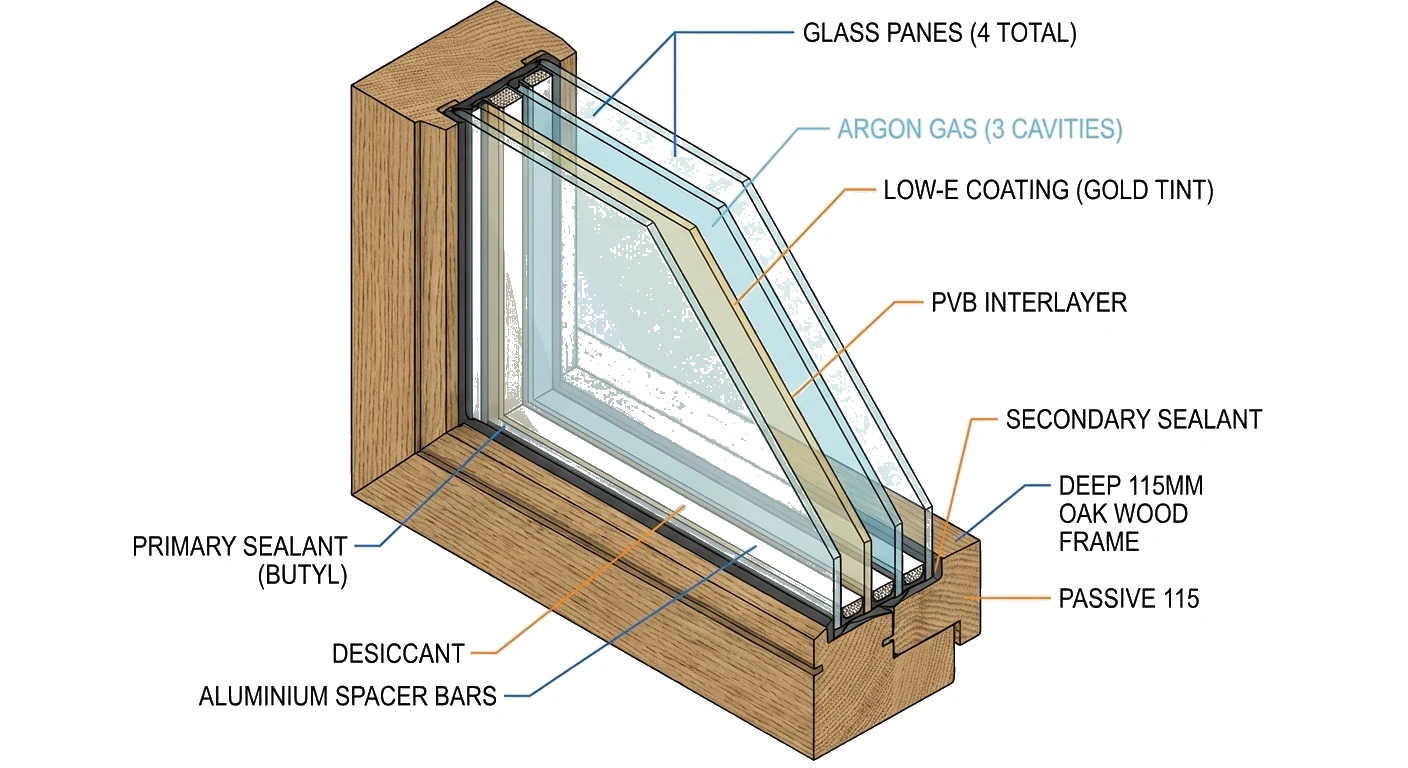
Adding a fourth pane sounds simple. It is not. The engineering challenge multiplies with each additional glass layer because you are managing more gas cavities, more coatings, more weight, and a fundamentally different thermal profile. A triple glazed unit with a typical 4-16-4-16-4 configuration uses two argon-filled cavities totalling about 44mm of glass and gas. Our quadruple glazed units run a 4-12-4-12-4-12-4 stack with three krypton-filled cavities, reaching approximately 56mm total thickness.
Why krypton instead of argon? Gas conductivity matters enormously at this performance level. Argon has a thermal conductivity of about 0.018 W/mK. Krypton drops to 0.0095 W/mK. That 47% reduction in gas conductivity is what allows narrower cavities (12mm vs 16mm) while still improving overall thermal resistance. Without krypton, a four-pane unit would need wider gaps, pushing total thickness past 60mm and creating problems with frame depth, hardware compatibility, and structural integrity.
Then there are the Low-E coatings. Triple glazing typically uses two Low-E surfaces. Quadruple glazing uses three. Each coating reflects long-wave infrared radiation back into the building, reducing radiative heat transfer between panes. But each coating also reduces visible light transmission by 3-5%. Stack three coatings and you lose roughly 10-15% of daylight compared to a similar triple unit. Is that acceptable? Depends entirely on the building, the orientation, and the client's priorities.
U-Values, Light, and Weight: The Numbers Side by Side
Specification decisions should rest on data, not marketing language. Here is how triple and quadruple glazing compare across the metrics that actually matter for building performance.
| Parameter | Triple Glazing (Argon) | Quadruple Glazing (Krypton) |
|---|---|---|
| Glass configuration | 4-16-4-16-4 (3 panes) | 4-12-4-12-4-12-4 (4 panes) |
| Total glass thickness | ~44 mm | ~56 mm |
| Ug (glass centre) | 0.5 - 0.7 W/m²K | 0.3 - 0.4 W/m²K |
| Uw (whole window) | 0.8 - 1.2 W/m²K | 0.6 W/m²K (PASSIVE 115) |
| Weight per m² | ~30 kg | ~40 kg |
| Light transmission | 70 - 72% | 62 - 65% |
| g-value (solar heat gain) | ~50% | 35 - 40% |
| Gas fill | Argon | Krypton |
| Low-E coatings | 2 surfaces | 3 surfaces |
| Sound insulation | Rw 32 - 36 dB | Rw 38 - 42 dB |
The Uw difference between 0.8 and 0.6 might look modest as a number. It is not modest as physics. That 0.2 W/m²K gap means roughly 25% less heat loss through the window. For a house with 30 m² of glazing facing a Nordic winter where the temperature differential between inside and outside averages 35 degrees across the heating season, that translates to measurable kWh savings. We will run those numbers in a moment.
Weight deserves attention too. Going from 30 to 40 kg per square metre adds 33% more load to the frame, the wall structure, and the installation crew's backs. A 1.5 m² quadruple glazed sash weighs 60 kg. That is a two-person lift every time. Hardware must be rated accordingly, and hinges need to handle the torque of a heavier sash over decades of operation.
The Real Cost of That Fourth Pane
Nobody publishes honest cost comparisons. We will.
A quadruple glazed window from our production costs approximately 25-35% more than an equivalent triple glazed unit in the same frame. The price increase comes from three sources: the additional glass pane itself (small), the krypton gas fill (significant), and the deeper frame profile required to accommodate the thicker glass unit (moderate). Krypton alone costs roughly 10 times more than argon per litre, and each cavity requires precise gas filling to maintain 90%+ concentration for rated performance.
But raw window cost is only half the equation. The real question is payback period. Consider a 150 m² house with 25 m² of window area in central Norway, where heating degree days average around 4,500 annually. Upgrading all windows from Uw 0.9 (good triple) to Uw 0.6 (quadruple with PASSIVE 115) reduces annual heat loss through windows by approximately 330 kWh. At Norwegian electricity prices of EUR 0.15-0.25/kWh, that saves EUR 50-82 per year.
The premium for quadruple over triple on 25 m² of window area runs roughly EUR 2,000-3,500 depending on configurations. Simple payback: 25-70 years on energy savings alone. That is not a compelling financial argument in isolation.
So why do people buy them? Three reasons that have nothing to do with energy bills.
First, certification. Passive House component certification sets a window threshold of Uw 0.80, but closing the overall energy balance on a cold-climate Passive House often needs windows near Uw 0.6, which triple glazing cannot deliver regardless of frame quality. That certification enables access to subsidies, green financing, and property value premiums that dwarf the window cost difference.
Second, comfort. A window surface temperature of 19 degrees (achievable with Uw 0.6) versus 16 degrees (typical with Uw 0.9) eliminates cold radiation near windows entirely. No cold downdrafts. No condensation risk. No need to position radiators under windows. This changes how you furnish and use every room with exterior glazing.
Third, future-proofing. Building regulations move in one direction. The UK tightened replacement window Uw across successive revisions (2.0 in 2002, 1.8 in 2006, 1.6 in 2010, 1.4 today), and Germany's GEG limit now sits at 1.3 with subsidy programmes targeting 0.95 and below. If requirements tighten toward Uw 0.6-0.7 within the next decade, today's triple glazed buildings will face window replacement or energy penalty charges. Windows installed today should last 40-60 years. Regulations will not wait that long.
When Triple Glazing Is Genuinely Enough
Honesty builds more trust than upselling. Triple glazing remains the right choice for the majority of projects, and we say that as a manufacturer that would profit from everyone choosing quadruple.
If your project sits in a climate zone with fewer than 3,000 heating degree days, triple glazing delivers excellent performance without the weight, cost, and light transmission penalties of a fourth pane. Southern England, the Netherlands, much of France, and coastal Denmark fall into this category. Our ECO 68 profile paired with quality triple glazing achieves Uw 1.0-1.1, which meets or exceeds current building codes in these regions with margin to spare.
Renovation projects present another strong case for triple. Older wall structures may not have been designed for the weight of quadruple glazing. A 40 kg/m² window in a 200-year-old timber frame house creates structural questions that a 30 kg/m² unit avoids entirely. The wall insulation in older buildings is typically the limiting thermal factor anyway - upgrading from double to triple glazing captures the largest performance jump. Going further to quadruple offers diminishing returns when the wall around the window performs at U 0.3 or worse.
South-facing elevations in temperate climates are another scenario where triple outperforms on balance. The higher g-value of triple glazing (50% vs 35-40% for quad) means more free solar heat gain during winter months. In well-designed passive solar homes, this solar contribution through south-facing windows can offset the thermal advantage of quadruple glazing for the entire elevation. Energy modelling software like PHPP can quantify this trade-off for specific projects.
Budget-constrained projects with large glazing areas should consider triple as well. If you have 40 m² of windows, the EUR 3,000-5,000 premium for quadruple might deliver better thermal returns if spent on improved wall insulation, mechanical ventilation with heat recovery, or air-tightness improvements instead.
When Quadruple Glazing Becomes Non-Negotiable
Certain projects cannot hit their performance targets without four panes, for reasons of building physics rather than preference.
Ultra-low-energy and cold-climate Passive House projects often need windows near Uw 0.6 to close the energy balance. No triple glazed window reaches that, regardless of frame technology, gas fill, or coating specification. When the target is that low, quadruple glazing is the only path. Our PASSIVE 115 frame at 115mm depth was specifically engineered for this requirement, with thermal breaks and insulation geometry optimized for the deeper glass unit.
Nordic new-build regulations effectively mandate quadruple performance in some scenarios. Norway's TEK17 sets a 0.8 prescriptive window target, with a 1.2 backstop where the whole-building energy frame is met, but ambitious municipalities and forward-thinking developers target Uw 0.6-0.7 to exceed minimum standards and qualify for enhanced green building ratings. Sweden's BBR technically allows Uw 1.2, but energy frame calculations for well-insulated houses in northern regions often push window requirements well below that threshold to balance the total energy budget.
High-altitude and extreme-cold projects have thermal requirements that triple simply cannot address efficiently. Above 1,500m elevation, heating degree days often exceed 5,500. At these values, the additional cost of quadruple glazing pays back within 15-20 years purely on energy savings, even before factoring in comfort improvements or certification benefits. Swiss alpine projects and Canadian mountain homes represent a growing market segment for our quadruple products.
Noise-sensitive locations benefit disproportionately from the fourth pane. The jump from Rw 35 dB (triple) to Rw 40+ dB (quadruple) is clearly noticeable, roughly a 30% drop in perceived loudness, though a full perceived halving takes a 10 dB improvement. For properties near airports, railways, or major roads, this acoustic improvement alone can justify the upgrade. Architects specify our quadruple glazed inward-opening windows specifically for bedroom and living areas in high-noise environments.
Regulations Are Deciding for You: Country Requirements in 2025-2026
Building energy codes vary dramatically across European markets. Understanding where your project falls determines whether triple or quadruple glazing is a choice or a requirement.
| Country/Standard | Max Uw Requirement | Best Practice Target | Triple Sufficient? |
|---|---|---|---|
| UK | 1.4 W/m²K (replacement, Part L) | 1.2 W/m²K (new-build notional, FHS 2026) | Yes, for most projects |
| Germany | 1.3 W/m²K (GEG 2024 limit) | 0.95 BEG / 0.8 KfW 40 (subsidy) | Marginal for KfW 40 |
| Norway | 1.2 W/m²K (TEK17 backstop) | 0.8 W/m²K (TEK17 measure) | At the limit |
| Sweden | 1.2 W/m²K (BBR) | 0.8 - 1.0 W/m²K | Yes, comfortably |
| Switzerland | 1.0 W/m²K (MuKEn) | 0.7 - 0.8 W/m²K | Depends on canton |
| Passive House (window cert) | 0.80 W/m²K (PHI, cool-temperate) | - | Yes, with ECO 92 |
| Cold-climate energy balance | ~0.6 - 0.7 W/m²K (project-driven) | - | No - quadruple territory |
Germany presents the most interesting case. The GEG 2024 legal limit is Uw 1.3, comfortably met by good triple glazing, but the subsidy-linked targets (0.95 under BEG, 0.8 under KfW 40) push triple to its absolute performance ceiling. Our ECO 92 profile can reach Uw 0.8 with optimized triple glazing, but there is zero margin for error in frame design, spacer selection, or installation quality. One thermal bridge in the installation detail, and the target slips away. Quadruple glazing in the same ECO 92 frame delivers Uw 0.7 with comfortable margin.
Norway illustrates where regulations are heading for all of Northern Europe. TEK17's Uw 0.8 already strains the practical limits of triple glazing in larger window formats. A 1800x2400mm triple glazed window with an aluminium spacer might test at Uw 0.85 - technically non-compliant. The same format in quadruple achieves Uw 0.65 without breaking a sweat.
From Our Factory Floor: What 100 Years of Woodworking Taught Us About Glass
Our production site in Kalnciems sits on land with over a century of woodworking heritage. The timber expertise is in the DNA of this place. But when we developed our quadruple glazing programme, the biggest lessons came from the glass side, not the wood side.
Spacer bars matter more than most people realize. We use warm-edge spacers (Psi value below 0.035 W/mK) on all quadruple units. Switching from standard aluminium spacers to warm-edge composite spacers improves the overall Uw by 0.05-0.08 W/m²K. On a window chasing Uw 0.6, that difference is enormous. It can mean the difference between certified and not certified. We have tested every major spacer brand available in Europe and settled on two suppliers whose products consistently deliver rated Psi values after accelerated aging tests.
Gas filling presents its own challenge at scale. Krypton is far more expensive than argon, commonly 8 to 15 times the price and volatile, and each quadruple glazed unit requires precise filling to 90% concentration or higher. Our production line uses automated gas-filling equipment with real-time concentration monitoring. Below 85% krypton concentration, the Ug value degrades noticeably. We reject any unit that falls below 90% and refill it. This quality control step adds cost, but there is no point manufacturing a premium product if you cannot guarantee its stated thermal performance.
Weight management starts at the design stage. A quadruple glazed fixed unit is straightforward - the frame bears a static load. But an opening sash with quadruple glazing at 40 kg/m² creates serious demands on hinges, handles, and locking mechanisms. We use premium hardware from GU (Gretsch-Unitas) rated for weights up to 130 kg per sash, and our hinge calculations include a 20% safety margin for long-term performance. A sash that opens smoothly on day one must open smoothly on year thirty.
The thermal testing that validates all of this happens at Kaunas University of Technology in Lithuania. Each new configuration undergoes hot-box testing according to EN 12567-1, measuring actual Uw performance under controlled conditions. Our Uw 0.6 figure for the PASSIVE 115 quadruple configuration is a measured value, not a calculated estimate. Testing costs EUR 3,000-5,000 per configuration, but it gives us numbers we can stand behind in any specification meeting.
One insight from production that rarely appears in glazing discussions: glass deflection. As atmospheric pressure changes, the gas in sealed cavities expands or contracts, causing the glass panes to bow inward or outward. With three cavities instead of two, quadruple glazing shows more complex deflection patterns. We manage this through careful cavity sizing and glass thickness selection, but it means quadruple units are more sensitive to altitude changes during transport. Shipping windows from our sea-level factory to a Swiss alpine site at 1,800m requires pressure equalization valves in the glass units - a detail that can cause failures if overlooked.
Profile Choice Determines Your Performance Ceiling
The glass unit gets the headlines, but the frame determines the real-world Uw value. A superb quadruple glass unit installed in a mediocre frame delivers mediocre overall performance. This is why we offer three distinct profile systems, each optimized for different glazing and performance tiers.
Our ECO 68 profile at 68mm depth handles triple glazing only. It achieves Uw 1.0-1.1 with standard triple glass units and is our entry point for markets where codes do not yet demand extreme performance. The UK, Sweden, and parts of France buy this profile heavily. Available in pine, oak, larch, and meranti, it suits renovation projects and new builds where budget efficiency matters more than chasing record U-values.
The ECO 92 sits in the middle at 92mm frame depth. It accommodates both triple and quadruple glazing, making it our most versatile profile. With optimized triple glazing, it reaches Uw 0.8 - exactly on the Passive House Classic threshold. With quadruple glazing, it achieves Uw 0.7. This profile sells into Germany, Norway, and Switzerland, where regulations demand high performance but not necessarily Passive House Premium certification.
PASSIVE 115 is purpose-built for quadruple glazing at 115mm depth. Every millimetre of that profile is engineered for thermal performance: multi-chamber insulation geometry, triple-seal weatherstripping, and a thermal break design that minimizes frame psi values. This is the only profile in our range that delivers certified Uw 0.6 with quadruple glazing. It targets Passive House Premium projects, extreme-climate installations, and clients who want the best thermal performance available in a timber window.
All three profiles are manufactured from laminated timber in our four available wood species. Larch and oak offer natural durability without chemical treatment, while pine provides the best value. Meranti, a tropical hardwood, delivers exceptional dimensional stability and rot resistance for demanding exterior exposures.
Solar Heat Gain: The Hidden Trade-Off Nobody Talks About
Every additional pane of glass reduces the amount of solar energy that enters the building. This matters more than most specification guides acknowledge.
Triple glazing with two Low-E coatings delivers a g-value of approximately 50%. That means half the solar radiation hitting the glass passes through as usable heat. On a south-facing window in winter, this free heat contribution is substantial. A 3 m² south-facing triple glazed window in central Europe might contribute 400-600 kWh of useful solar heat over a heating season.
Quadruple glazing drops the g-value to 35-40%. The same 3 m² window now contributes only 280-400 kWh. That is 120-200 kWh less free heating. In some building designs, particularly those optimized for passive solar gain, the reduced solar contribution through quadruple glazing partially offsets the improved insulation. Energy modelling with PHPP or similar tools reveals whether the net effect is positive or negative for each specific project, orientation, and climate.
South-facing windows in climates with significant winter sunshine (continental climates, Alpine regions, Scandinavia) often perform better as high-quality triple than as quadruple. North-facing windows, which receive almost no useful solar gain anyway, benefit purely from reduced heat loss - making quadruple the clear winner on north elevations.
Smart specification means mixing glazing types by orientation. We regularly produce projects where south-facing windows use ECO 92 with triple glazing (maximizing solar gain) while north, east, and west elevations use PASSIVE 115 with quadruple glazing (minimizing heat loss). This hybrid approach can outperform whole-house quadruple glazing in total energy performance while reducing both cost and weight.
Frequently Asked Questions
Can I retrofit quadruple glazing into existing triple-glazed frames?
No. Quadruple glass units are approximately 12mm thicker than triple units (56mm vs 44mm), and they weigh 33% more per square metre. Existing frames lack the rebate depth, structural capacity, and hardware ratings required for quadruple glazing. Retrofitting requires complete window replacement with frames designed for the deeper, heavier glass unit. Our ECO 92 and PASSIVE 115 profiles are engineered specifically for this purpose.
How long does krypton gas remain effective in a sealed unit?
High-quality sealed units lose gas at a rate of approximately 1% per year through permeation and seal aging. At this rate, krypton concentration stays above 85% for 15+ years, maintaining rated thermal performance throughout that period. Our units are manufactured with initial concentrations above 90% and tested for seal integrity according to EN 1279. The practical service life of the gas fill exceeds 20 years before performance degradation becomes meaningful.
Does quadruple glazing make rooms noticeably darker?
Light transmission drops from 70-72% (triple) to 62-65% (quadruple). In practice, most occupants cannot perceive this difference because the human eye adapts to gradual light level changes. The difference becomes noticeable only in direct side-by-side comparison or in rooms with limited window area. For rooms with generous glazing (window-to-floor ratio above 20%), the difference is imperceptible. Rooms with smaller windows in northern climates may benefit from triple glazing's higher light transmission.
What is the expected lifespan of quadruple glazed windows?
The timber frame lasts 40 years as a minimum, and 60+ years with maintenance, while the sealed glass unit has a functional life of 25-30 years before gas loss might warrant replacing the unit (straightforward, without changing the frame). We cover frame longevity and the repainting cycle in detail in our guides on how long timber windows last and repainting timber windows.
Are quadruple glazed windows suitable for listed or heritage buildings?
Yes, with careful design consideration. Our timber frames can be manufactured with traditional external profiles that match period aesthetics while housing modern quadruple glass units inside. The deeper frame (115mm for PASSIVE 115) can be accommodated in most wall constructions. For particularly sensitive heritage contexts, our ECO 92 profile at 92mm depth offers a more discrete option with quadruple glazing at Uw 0.7. We have supplied heritage-sensitive projects across Europe, including protected buildings in the UK, Norway, and Switzerland. Check our fire-rated wooden windows guide for another example of how traditional timber frames accommodate modern performance requirements.
The Verdict: When the Fourth Pane Earns Its Place
Quadruple glazing is not universally better than triple. It is better for specific conditions, specific buildings, and specific performance targets. Treating it as a blanket upgrade wastes money. Treating it as unnecessary ignores where building physics is heading.
If your project targets Passive House Premium, needs certified Uw 0.6, sits in a climate above 4,000 heating degree days, or faces noise exposure that demands Rw 40+ dB - quadruple glazing is not optional. It is the only product that delivers. Our PASSIVE 115 profile exists precisely for these applications.
For everything else, excellent triple glazing in the right frame (our ECO 92 delivers Uw 0.8) remains the smart choice. It costs less, weighs less, transmits more light, captures more solar heat, and meets current codes across most of Europe. The money saved on glazing often buys better overall building performance when invested in wall insulation, air-tightness, or ventilation.
The fourth pane earns its place when the third one runs out of physics. Talk to our technical team with your project's energy targets, and we will tell you honestly which solution delivers the best performance per euro. Sometimes that answer is three panes. Sometimes four. We manufacture both, and our recommendation depends on your building - not our margin.
Ready to specify? Homeowners start here. Architects and developers start here.
Need Expert Advice?
Our team can help you choose the right windows for your project - from energy ratings to installation.
Get a Free Quote